For those of you not already aware, I have an exciting announcement to make - as of today, I have finally achieved my long-standing goal of becoming a fully professional motorsport journalist after being invited to join the fast-growing team of writers at motorsport.com as UK Editor.
My appointment at motorsport.com is the culmination of a long, pain-staking process that begun in earnest just over five years ago, when I published my first post to this blog. I may only have had a relatively modest amount of hits since - about 23,500 as of the time of writing, which equates only to just over 100 hits per article - but the purpose of this blog was never to rack up of tens of thousands of hits, but to provide a vehicle to express my opinions and to hone my writing style. I like to think that I've achieved both of those aims; you need only to look back at some of my early work to see just how far I have progressed!
For some time now I haven't been able to update this blog as regularly as I'd have liked, but of course the demands of my new role mean that I will now have virtually no time to devote to it at all. As a result, I intend to turn it into something of a travel blog, documenting some of my adventures watching motor racing around the world in between dedicating myself to my new employers.
The events that I am attending this year and that I hope to cover in this way are:
- 24 Hours of Le Mans (13-14 June)
- Formula E at Battersea Park (27-28 June)
- DTM at Zandvoort (11-12 July)
- Belgian Grand Prix (22-23 August)
- IndyCar at Sonoma (29-30 August)
So, all that remains for me to say a very warm thank you for looking at this blog - I suppose everyone who's read anything of mine has, in a small way, helped me to get where I am today, and for that I am extremely grateful. Of course, I will be generating plenty of material this year over at motorsport.com, including reporting full-time on both the BTCC and British GT championships, so I encourage you to check the site out regularly for all your Formula 1 and motor racing news.
1 April 2015


7 March 2015
A 2015 F1 Season Preview (of sorts)
Anyone who watched last night's F1 Show on Sky Sports may have noticed an oddly familiar face lurking in the studio audience behind Simon Lazenby, Natalie Pinkham and co. That's because I was fortunate enough to attend the first recording of the new series at the Sky Studios in Brentford alongside my good friend Dougie Wilson, as evidenced by the below picture (I'm to the left of the fellow in the Lotus top, for the avoidance of doubt):

I should confess at this stage that I am in fact not a regular F1 Show viewer - I would describe it as perfectly decent, but hardly essential viewing for the motor racing fan, particularly later in the year when there are fewer obvious topics for discussion and when there is a tendency to rely more heavily on special guests and rather esoteric feature pieces.
But, being the first show of the year, there was happily much to discuss on this occasion, ranging from which teams shone in winter testing to the mystery surrounding Fernando Alonso's enforced lay-off from the season-opening Australian Grand Prix in a week's time and the recent resurrection of the Manor (née Marussia) squad. More on all that later, though.
For a regular viewer of Sky's F1 coverage, watching on as the presenters did their thing was something of a surreal experience, similar to that of watching Grand Prix cars in the flesh for the first time. It's a reminder that, for all the glitz and glamour of the F1 paddock, those fronting the coverage are really just ordinary human beings like you or I.
Not only that, but they are genuinely pleasant people, perhaps unsurprisingly given the nature of their work. Lazenby and Pinkham, along with the affable Johnny Herbert, made a real effort to interact with the audience both before and after the show, as well as during the ad breaks and VTs, making the whole business of standing up for an hour in a television studio a strangely enjoyable experience.
Indeed, after the show, I got to have a brief chat with Pinkham - I asked who her favourite drivers to interview were; Daniel Ricciardo, Valtteri Bottas and Jenson Button were the three names I got in return. When I asked whether there were any she was less keen on speaking to, she said there weren't, and that extracting a response from the famously laconic Kimi Raikkonen was a fun challenge!
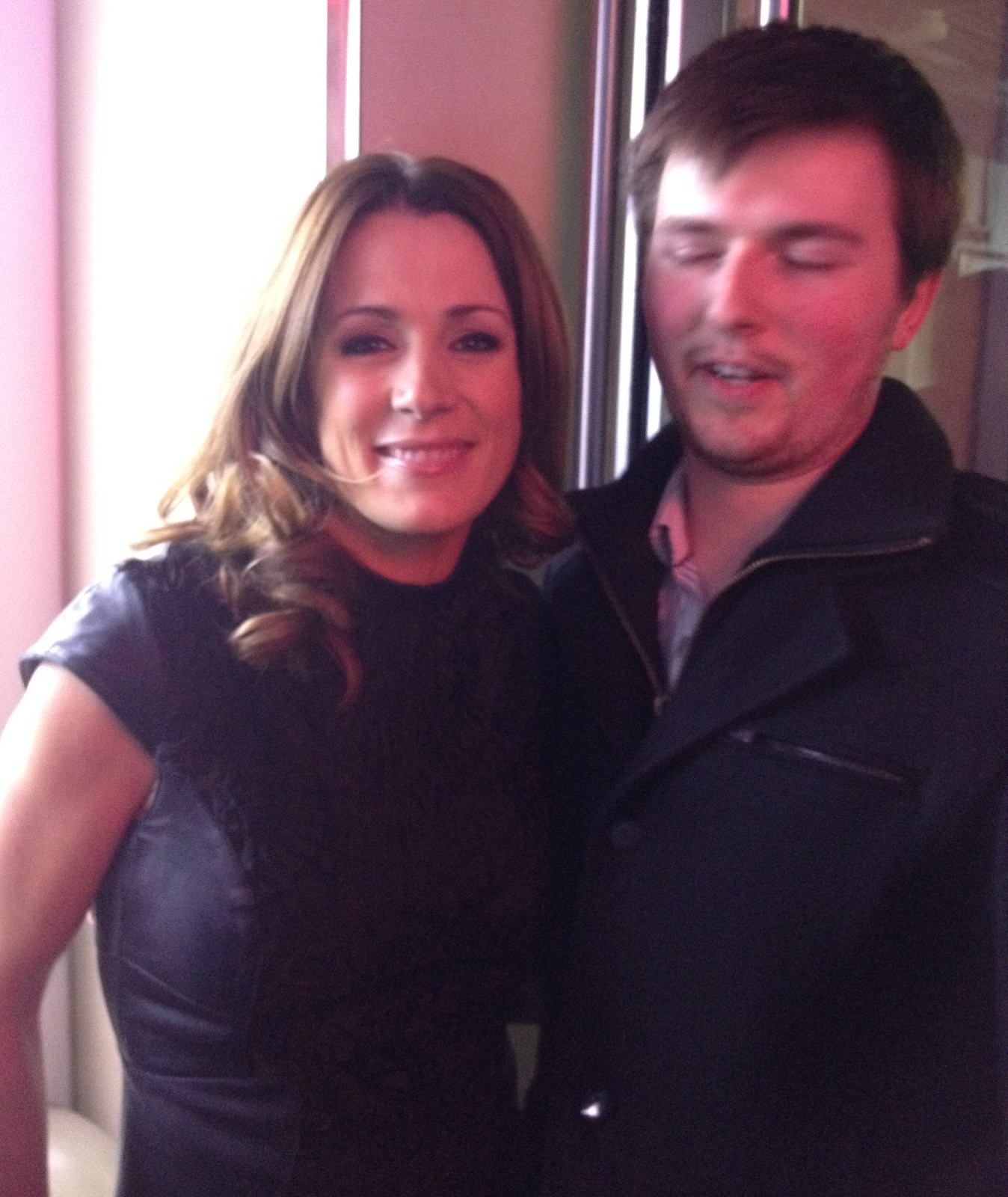
Regrettably, the picture I had taken with her has to rank among the worst there's ever been of me - eyes shut, mouth agog and double chin in full view. A similar fate befell me when I bumped into Martin Brundle in the Monza pitlane last September, so perhaps I have some sort of allergy to Sky Sports presenters.
Moving swiftly on, Alonso's testing crash and its aftermath have understandably dominated the motor racing headlines in recent days. Though next weekend's curtain-raiser will be all the poorer without the Spaniard making his hotly anticipated McLaren-Honda bow, missing the race is unquestionably the right course of action, given the well documented risks associated with sustaining a second concussion so soon after the first.
That said, I still can't help but get the feeling that there's something amiss about the whole saga. Question marks remain over whether Alonso was indeed conscious at the time of his impact with the barriers at the Circuit de Catalunya, and it's not hard to see why McLaren would be keen to ensure Honda is spared the mortifying embarrassment of having to admit fault for the accident that has benched the team's multi-million dollar star signing.
I should confess at this stage that I am in fact not a regular F1 Show viewer - I would describe it as perfectly decent, but hardly essential viewing for the motor racing fan, particularly later in the year when there are fewer obvious topics for discussion and when there is a tendency to rely more heavily on special guests and rather esoteric feature pieces.
But, being the first show of the year, there was happily much to discuss on this occasion, ranging from which teams shone in winter testing to the mystery surrounding Fernando Alonso's enforced lay-off from the season-opening Australian Grand Prix in a week's time and the recent resurrection of the Manor (née Marussia) squad. More on all that later, though.
For a regular viewer of Sky's F1 coverage, watching on as the presenters did their thing was something of a surreal experience, similar to that of watching Grand Prix cars in the flesh for the first time. It's a reminder that, for all the glitz and glamour of the F1 paddock, those fronting the coverage are really just ordinary human beings like you or I.
Not only that, but they are genuinely pleasant people, perhaps unsurprisingly given the nature of their work. Lazenby and Pinkham, along with the affable Johnny Herbert, made a real effort to interact with the audience both before and after the show, as well as during the ad breaks and VTs, making the whole business of standing up for an hour in a television studio a strangely enjoyable experience.
Indeed, after the show, I got to have a brief chat with Pinkham - I asked who her favourite drivers to interview were; Daniel Ricciardo, Valtteri Bottas and Jenson Button were the three names I got in return. When I asked whether there were any she was less keen on speaking to, she said there weren't, and that extracting a response from the famously laconic Kimi Raikkonen was a fun challenge!
Regrettably, the picture I had taken with her has to rank among the worst there's ever been of me - eyes shut, mouth agog and double chin in full view. A similar fate befell me when I bumped into Martin Brundle in the Monza pitlane last September, so perhaps I have some sort of allergy to Sky Sports presenters.
Moving swiftly on, Alonso's testing crash and its aftermath have understandably dominated the motor racing headlines in recent days. Though next weekend's curtain-raiser will be all the poorer without the Spaniard making his hotly anticipated McLaren-Honda bow, missing the race is unquestionably the right course of action, given the well documented risks associated with sustaining a second concussion so soon after the first.
That said, I still can't help but get the feeling that there's something amiss about the whole saga. Question marks remain over whether Alonso was indeed conscious at the time of his impact with the barriers at the Circuit de Catalunya, and it's not hard to see why McLaren would be keen to ensure Honda is spared the mortifying embarrassment of having to admit fault for the accident that has benched the team's multi-million dollar star signing.
Either way, McLaren's handling of the situation has been poor, much like its protracted dithering over finalising its 2015 drivers over the winter, with the Woking outfit seemingly contradicting their own press statements regarding Alonso's condition. Here's hoping that the FIA's investigation into the incident is able to shed some light where McLaren is seemingly unwilling to.
There's a certain irony in the fact that the team will be running the same line-up in Melbourne as last year, as Kevin Magnussen fills the breach alongside Button. For the Dane, it's an invaluable chance to show McLaren what they will be missing this season, assuming Alonso returns for Malaysia as expected, and perhaps to showcase himself to other potential suitors for 2016, given that Alonso and Button are both under contract for next season.
The other big story of the past couple of weeks has been the revival of the Manor team, a rare piece of good news that ensures that there will be 20, rather than just 18, cars on the grid in Australia. The man F1 fans have to thank for this is energy mogul and self-confessed petrolhead Stephen Fitzpatrick, who has reportedly invested £30m into the team known last year as Marussia to get the operation back on its feet.
The team's chief executive Graeme Lowdon - a true racer if ever there was one - and its only confirmed driver as of the time of writing, Will Stevens, were both present at the F1 Show recording, and I managed to share a word with the latter after the show. At least the picture I had with him wasn't quite as repulsive as my snap with Pinkham.

Stevens has spent the last three seasons in Formula Renault 3.5, in which his record would be best described as solid rather than spectacular, but proved on his one-off appearance for Caterham last year at Abu Dhabi that he's a perfectly competent operator behind the wheel of an F1 car. Asked how he found the transition from FR3.5, he remarked that the step up in power was the main difference, and that the cornering speeds were similar given the Caterham's woeful aerodynamic package.
The 23-year-old wouldn't be drawn on the identity of his Manor team-mate, although one name I mooted to him was former GP2 champion Fabio Leimer, who had been due to race in the Japanese-based Super Formula this season before splitting with his team yesterday. Stevens, who admitted that 2015 is likely to be largely a learning year, struck me as quite an intense and single-minded character, traits that will serve him well in the F1 paddock.
While Manor is likely to languish at the bottom of this year's constructors' table, running a modified version of last year's Marussia to begin with, winter testing suggests that Mercedes will almost certainly be the runaway victor once more this season. Nico Rosberg's best time at Catalunya was three tenths quicker than the nearest non-Mercedes, Bottas, despite being set on soft compound tyres and not the faster super-soft compound like the Williams driver.
That means fans are most probably in for another head-to-head battle between defending champion Lewis Hamilton and Rosberg as far as the drivers' crown is concerned. At 4/6, the Brit begins the season as heavy favourite to take a third title, but Sky Deutschland's Tanja Bauer advised the F1 Show audience not to write off the hopes of Rosberg, who, as she pointed out, should be stronger now with the experience of a title battle under his belt.
There's a certain irony in the fact that the team will be running the same line-up in Melbourne as last year, as Kevin Magnussen fills the breach alongside Button. For the Dane, it's an invaluable chance to show McLaren what they will be missing this season, assuming Alonso returns for Malaysia as expected, and perhaps to showcase himself to other potential suitors for 2016, given that Alonso and Button are both under contract for next season.
The other big story of the past couple of weeks has been the revival of the Manor team, a rare piece of good news that ensures that there will be 20, rather than just 18, cars on the grid in Australia. The man F1 fans have to thank for this is energy mogul and self-confessed petrolhead Stephen Fitzpatrick, who has reportedly invested £30m into the team known last year as Marussia to get the operation back on its feet.
The team's chief executive Graeme Lowdon - a true racer if ever there was one - and its only confirmed driver as of the time of writing, Will Stevens, were both present at the F1 Show recording, and I managed to share a word with the latter after the show. At least the picture I had with him wasn't quite as repulsive as my snap with Pinkham.
Stevens has spent the last three seasons in Formula Renault 3.5, in which his record would be best described as solid rather than spectacular, but proved on his one-off appearance for Caterham last year at Abu Dhabi that he's a perfectly competent operator behind the wheel of an F1 car. Asked how he found the transition from FR3.5, he remarked that the step up in power was the main difference, and that the cornering speeds were similar given the Caterham's woeful aerodynamic package.
The 23-year-old wouldn't be drawn on the identity of his Manor team-mate, although one name I mooted to him was former GP2 champion Fabio Leimer, who had been due to race in the Japanese-based Super Formula this season before splitting with his team yesterday. Stevens, who admitted that 2015 is likely to be largely a learning year, struck me as quite an intense and single-minded character, traits that will serve him well in the F1 paddock.
While Manor is likely to languish at the bottom of this year's constructors' table, running a modified version of last year's Marussia to begin with, winter testing suggests that Mercedes will almost certainly be the runaway victor once more this season. Nico Rosberg's best time at Catalunya was three tenths quicker than the nearest non-Mercedes, Bottas, despite being set on soft compound tyres and not the faster super-soft compound like the Williams driver.
That means fans are most probably in for another head-to-head battle between defending champion Lewis Hamilton and Rosberg as far as the drivers' crown is concerned. At 4/6, the Brit begins the season as heavy favourite to take a third title, but Sky Deutschland's Tanja Bauer advised the F1 Show audience not to write off the hopes of Rosberg, who, as she pointed out, should be stronger now with the experience of a title battle under his belt.
Testing suggests that the teams most likely to begin the year as best of the rest are Williams and Ferrari, whose James Allison-penned contender already looks to be a major step forward. Sebastian Vettel seems at home with his new employers, having regained his trademark boyish charm that he lacked during a subdued 2014, while Raikkonen, who struggled badly last year with a car lacking in front-end grip, also appears happier with his mount and will no doubt be eager to silence his critics.
Red Bull meanwhile still seem to be lagging somewhat, in no small part because of the travails of engine supplier Renault, but it should be remembered that Red Bull still bagged a (later disallowed) second-place finish following a dismal winter this time a year ago. What's more, Adrian Newey may no longer be involved with the Milton Keynes-based team on a day-to-day basis, but the RB11 still bears his hallmarks, and the design guru will doubtless have a bearing on its development.
Some pundits reckon there's plenty of potential locked away inside the aggressive Peter Prodromou-influenced McLaren, but it will be up to Honda to catch up with its rivals if the chassis' latent speed is to be realised. Winter testing will have come as a major wake-up call for a team that was talking up its chances of challenging Mercedes for Grand Prix wins off the bat, as well as a sober reminder that this is a long-term project and that both constructor and engine supplier will need to be patient.
As for the rest, the new Mercedes-powered Lotus looks solid, and should be a regular points contender, while the respective offerings from Toro Rosso and Sauber also both appear stronger than their predecessors. The team that could struggle most initially is Force India, which, owing to financial problems, only managed to complete two-and-a-half days of running with its 2015 car over the winter, but its Mercedes powerplant should help to mitigate their competitive slide to a degree.
Bearing in mind all of the above, here are my predictions for the top 10 in Melbourne, as well as for this year's championship:
Melbourne predictions: 1. Hamilton, 2. Rosberg, 3. Bottas, 4. Vettel, 5. Ricciardo, 6. Massa, 7. Raikkonen, 8. Grosjean, 9. Kvyat, 10. Verstappen
Season predictions: 1. Hamilton, 2. Rosberg, 3. Ricciardo, 4. Vettel, 5. Bottas, 6. Raikkonen, 7. Alonso, 8. Massa, 9. Kvyat, 10. Grosjean
As much as I would like to think that this season will prove at least as competitive as last year's titanic tussle between the Mercedes duo, I suspect Hamilton may just be too strong for Rosberg this year, especially if he is able to improve the qualifying form that appeared to desert him at times last season.
Ricciardo's undoubted class allied to an improving Red Bull will be enough for the Aussie to overhaul Vettel for third place, while Williams will lose ground towards the end of the year, limiting Bottas to fifth ahead of compatriot Raikkonen, who will be closer to his team-mate's pace than he was last year.
After a slow start to the year, Alonso will gradually work his way up to seventh in the final standings, with a couple of podium finishes to his credit, pipping Massa and Kvyat. Grosjean will round out the top 10 just ahead of Button, the Brit finding the task of matching his fellow McLaren driver tougher than expected.
Red Bull meanwhile still seem to be lagging somewhat, in no small part because of the travails of engine supplier Renault, but it should be remembered that Red Bull still bagged a (later disallowed) second-place finish following a dismal winter this time a year ago. What's more, Adrian Newey may no longer be involved with the Milton Keynes-based team on a day-to-day basis, but the RB11 still bears his hallmarks, and the design guru will doubtless have a bearing on its development.
Some pundits reckon there's plenty of potential locked away inside the aggressive Peter Prodromou-influenced McLaren, but it will be up to Honda to catch up with its rivals if the chassis' latent speed is to be realised. Winter testing will have come as a major wake-up call for a team that was talking up its chances of challenging Mercedes for Grand Prix wins off the bat, as well as a sober reminder that this is a long-term project and that both constructor and engine supplier will need to be patient.
As for the rest, the new Mercedes-powered Lotus looks solid, and should be a regular points contender, while the respective offerings from Toro Rosso and Sauber also both appear stronger than their predecessors. The team that could struggle most initially is Force India, which, owing to financial problems, only managed to complete two-and-a-half days of running with its 2015 car over the winter, but its Mercedes powerplant should help to mitigate their competitive slide to a degree.
Bearing in mind all of the above, here are my predictions for the top 10 in Melbourne, as well as for this year's championship:
Melbourne predictions: 1. Hamilton, 2. Rosberg, 3. Bottas, 4. Vettel, 5. Ricciardo, 6. Massa, 7. Raikkonen, 8. Grosjean, 9. Kvyat, 10. Verstappen
Season predictions: 1. Hamilton, 2. Rosberg, 3. Ricciardo, 4. Vettel, 5. Bottas, 6. Raikkonen, 7. Alonso, 8. Massa, 9. Kvyat, 10. Grosjean
As much as I would like to think that this season will prove at least as competitive as last year's titanic tussle between the Mercedes duo, I suspect Hamilton may just be too strong for Rosberg this year, especially if he is able to improve the qualifying form that appeared to desert him at times last season.
Ricciardo's undoubted class allied to an improving Red Bull will be enough for the Aussie to overhaul Vettel for third place, while Williams will lose ground towards the end of the year, limiting Bottas to fifth ahead of compatriot Raikkonen, who will be closer to his team-mate's pace than he was last year.
After a slow start to the year, Alonso will gradually work his way up to seventh in the final standings, with a couple of podium finishes to his credit, pipping Massa and Kvyat. Grosjean will round out the top 10 just ahead of Button, the Brit finding the task of matching his fellow McLaren driver tougher than expected.
20 February 2015
Five sporting rule changes to boost Formula 1
In recent months, there has been plenty of debate within the
Formula 1 fraternity regarding the direction the sport should take. While there
appears to be a consensus forming regarding such proposals as returning to
1,000-horsepower-plus engines and wider tyres, addressing F1’s ills by altering
the technical regulations is only part of the story.
Little has been suggested as to how to the sporting rules
might be moulded to improve F1, which seems like something of an oversight considering
how much easier and quicker it would be to implement such changes than reimagining
what a Grand Prix car should be.
That’s why I’ve devised a list of five relatively radical changes
to the sporting regulations, all of which could theoretically be implemented no
later than next season. Some would have a knock-on effect on how teams would
have to design their cars, but none of them are technical rule changes per se.
I’ve also avoided the thorny issue of how prize money ought
to be distributed – as much of an impediment to a truly competitive
championship as the present arrangement is – as well as the way the sport is
governed in the Strategy Group era. Those are arguments for another article.
The following changes also don’t include any provisions
explicitly aimed at boosting grid numbers from their current low ebb, though
their indirect effect may well be to improve the spectacle to a point where
more would-be sponsors and team owners decide they want to be involved.
1. Replace qualifying
with a reverse grid sprint race
Rules heralding a dramatic reduction in aerodynamics are
often mooted to generate more passing, but the very nature of modern F1 would
make it impossible to reintroduce all the variables that made Grand Prix racing
of yore so unpredictable. Instead, it’s time to consider something more radical
– something that forces teams to produce cars able to overtake one another more
easily.
Traditionalists may baulk at the thought of reverse grids,
but there’s no doubting that forcing faster cars to overtake slower ones on a
routine basis is a sure-fire way of generating the wheel-to-wheel action fans
crave. The non-points paying sprint race
format helps to moderate the random effect that reverse grids could have on the
championship if used in the actual Grands Prix themselves.
Grid order for the sprint races would be determined by
simply reversing the order of the championship as it stands before each race, meaning
the fastest cars would generally be at the back and the slowest at the front,
also providing some sorely needed TV coverage for the minnows. For the first
race, the grid would be determined by the previous year’s final standings.
The sprints would be approximately 45 minutes in length, with
no pitstops permitted (except to repair damage), and each driver would use a
single set of prime tyres; DRS would have to be scrapped to prevent the
quickest cars scything their way through the order too rapidly. The finishing
order would then determine the grid for the main event, with any retirees
starting at the back.
Over the course of the season, the best car-driver combination
would still prevail, but with more emphasis on the driver given the premium that
reverse-grid sprints would place on the ability to pass – something even the
purists can surely agree would be a good thing for the sport.
2. Overhaul tyre
compound rules
Another way to spice up Grands Prix would be the creation of
more strategic variables, meaning a rethink of the rules surrounding tyre usage
is in order. As much as this writer would love to see a return to a tyre war
(for the same reasons there would never be standardised engines, or even
chassis, in F1), there’s still plenty that can be done in the context of a sole
tyre supplier.
Pirelli has said in the past that they would be willing to
expand their range of dry tyre compounds from the present level of four, if
that’s what teams wanted – it’s the time for that offer to be taken up, with
each team given the ability to choose their own ‘prime’ and ‘option’ for each
race weekend, barring any compounds Pirelli deems unsafe for a particular
track.
Thus, teams could opt to gamble on using softer tyres than normal
in order to gain competitive advantage during the race, introducing a new layer
of intrigue and providing more opportunity for smaller teams to overcome their
bigger rivals through sheer tactical guile alone. The need to use both tyre
compounds in a race to promote strategic variation would also no longer exist.
This new set of tyre rules could work both with the new
sprint-race proposal outlined above, or with the existing qualifying format. In
the latter case, there would be nothing to stop teams using softer tyre
compounds to claw their way up the grid, but at the expense of being able to run
lengthy stints in the races, providing a suitable risk-to-reward ratio.
3. Reserve FP1 for
third and reserve drivers
Most observers agree that F1 needs to do more to give its
stars of the future more track time, but little meaningful change has been
effected in recent years to that end. The end-of-season young driver test was a
(small) step in the right direction, but even that’s been effectively replaced
by a return to limited in-season testing, in which teams are not obliged to run
young drivers.
Proposals to create new test sessions specifically for
rookies tend to be shot down because of cost concerns, and understandably so
given the current financial climate in the sport, and introducing third cars to
be raced by inexperienced drivers opens up a whole new can of worms that is, on
balance, probably best avoided entirely.
The solution? Simply mandate that teams must use their third
driver during FP1 at every Grand Prix weekend. Immediately, young drivers gain
hours of valuable track time at no extra expense to the teams, while the
designation of reserve driver would become meaningful once again as each team
would have a driver totally familiar with the car and ready to step in if
needed.
Some teams already reward their third drivers with the odd
practice session, and in almost all cases they do a perfectly competent job of
setting up the car, ready for the regular driver to take the reins once again
in FP2. There would be an incentive for teams to employ truly capable reserves,
but the rise of young driver schemes means that there’s no shortage of those.
4. Apply engine token
system to chassis upgrades
Since the introduction of the new engine formula last year,
a compromise ‘token’ system has been in place, allowing manufacturers to
develop their power-units to a degree without the associated costs of a full-on
engine war.
Despite disagreements over the precise amount of tokens
manufacturers should be permitted to spend, and a brief controversy over how
homologation rules should apply to new boy Honda, there seems to be a broad
consensus that the token system itself is fundamentally one that works – so why
not apply it to chassis development too?
Teams would still produce new cars for each season, but they
wouldn’t be free to develop them as they saw fit beyond a certain homologation
date; as with engines, each component would be assigned a token value depending
on its effect on performance, with a limited number to spend throughout the
year.
This would level the playing field to a certain extent,
effectively preventing the biggest outfits from spending their way out of
trouble and allowing smaller teams to maintain any early advantage gained for
longer. In essence, teams would be forced to deploy their available resources
more carefully, arguably the next best thing after a utopian budget cap.
5. Make ‘blue riband’
events more significant
Only four circuits on the current calendar featured in F1’s
inaugural season back in 1950 – Monaco, Silverstone, Spa and Monza. This
quartet, which all boast the atmosphere, heritage and soul that no amount of
Middle Eastern oil wealth can buy, could be seen as the closest equivalent that
the sport has to the ‘major tournaments’ of golf and tennis.
Perhaps, then, F1 should make more of these ‘blue riband’
events by making them more significant milestones in the Grand Prix season.
While offering double points at Abu Dhabi was rightly derided by fans and
insiders alike, there could be some merit in awarding extra points at extended
versions of the four ‘major’ races at the four classic tracks listed above.
The four ‘blue riband’ races could be easily be made around
a third longer without unduly compromising the schedule, also solving the issue
of races at Monza and Spa regularly lasting less than 90 minutes. Naturally,
fuel tanks would need to be made larger to accommodate the extra fuel needed, a
change that could easily be implemented in time for the start of 2016.
The other implication of conferring a special status on
Monaco, Silverstone, Spa and Monza would be to help ensure they remain on the
calendar indefinitely. While feathers would no doubt be ruffled at FOM, fans
would surely welcome an FIA intervention to prevent the four above Grands Prix
from suffering the same fate that the German Grand Prix appears to be heading
towards.
6 February 2015
A Guide to the Le Mans Entry List
The day that the Automobile Club de l'Ouest take the wraps off the entry list for the 24 Hours of Le Mans is the one that really marks the start of the European sportscar racing season.
Despite the rise in prestige of the World Endurance Championship of which Le Mans is part, the French endurance classic remains the dominant feature of the sportscar racing landscape, and securing one of the 56 starting slots can be make-or-break for many of the sport's smaller concerns.
It's also traditionally the time that the driver line-ups, particularly at the sharp end of the grid, take further shape, and this year was no exception, with Porsche and newcomer Nissan both making driver announcements (more on those later) to coincide with the entry list reveal.
The latter's launch of its radical, front-engined, front-wheel drive GT-R LM Nismo is a perfect illustration of the rude health sportscar racing finds itself in currently. The rulebook allows each manufacturer to take its own approach that matches its own needs - ensuring that racing programmes remain an asset, rather than a liability, to their parent companies even if results aren't as hoped.
The variety that's seen in the LMP1 category of sportscar racing is a far cry from that seen in Formula One, where the need to prevent costs from spiralling out of control has led to an extremely prescriptive set of regulations that has made Grand Prix racing a much less attractive destination for auto-makers than was the case some 15 years ago.
The current strength of the prototype category is reflected by the fact that there will be 14 entries in the top division at Le Mans, including three privateers, the most there have been since 2011. They are supplemented by no fewer than 20 LMP2 cars - more cars are set to race in that class alone than in F1 this season - and 22 GTE cars split across the 'Pro' and 'Am' divisions.
Of these 56 starters, 35 are set to contest the full WEC season - 11 in LMP1, 10 in LMP2 and 14 across the two GTE categories, representing a 25 percent increase from last season, the ACO deciding to break its self-imposed limit of 32 entries in the face of such heightened demand to be part of one of motorsport's fastest growing championships.
LMP1
There were few surprises when it came to the unveiling of the Le Mans entry list in the highest division, with Audi, Porsche and Nissan all entering three cars, Toyota and Rebellion Racing two apiece and ByKolles (née Lotus) fielding a single car. What remains to be seen is whether Toyota will regret not entering a third car, as all three of its rivals have done, in the WEC's showpiece event.
Furthermore, on the driver front, Toyota appears to be putting its eggs largely in one basket as Kazuki Nakajima moves across to join defending WEC champions Anthony Davidson and Sébastien Buemi in the #1 car in place of the departed Nicolas Lapierre, meaning that the team's strongest three drivers from 2014 will all be concentrated in one line-up.
Meanwhile, Mike Conway, who contested three WEC races last year when Nakajima had clashing commitments in Japan, steps up to join Alex Wurz and Stéphane Sarrazin in the #2 car - a strong trio, no doubt, but on the evidence of last year not as formidable as that of the sister machine. A recent tweak to the rulebook regarding weight penalties for heavier drivers could help close the gap, though.
As a result of Toyota's WEC success last year, Audi will be using the less familiar numbers of #7, #8 and #9 at this year's Le Mans. Last year's winners André Lotterer, Benoît Tréluyer and Marcel Fässler remain a unit, and must be considered the German outfit's best chance of victory, particularly now that nine-time race winner Tom Kristensen has called time on his long and illustrious career.
Stepping up to replace the Dane is Oliver Jarvis, who joins Lucas di Grassi and Loïc Duval in the second full-season entry, standout Audi GT driver René Rast taking the Briton's place in the third car alongside Filipe Albuquerque and Marco Bonanomi. There's no doubting Jarvis' quality, but it will take time for him to gel with his new team-mates and for the #8 trio to be as strong as the #7.
Porsche are running the same full-season drivers as last year, Timo Bernhard, Brendon Hartley and F1 convert Mark Webber in the #17, and Romain Dumas, Neel Jani and Marc Lieb in the #18. The latter was conclusively the stronger line-up last year, Jani in particular establishing himself as a member of the WEC's elite crop - expect the Swiss to spearhead Porsche's challenge this time around.
As for the team's third car, the question of who would join Force India F1 star Nico Hulkenberg has finally been answered. Nick Tandy's promotion from Porsche's GT stable to the prototype ranks was no less than expected, but Earl Bamber's surprise leap from the Porsche Supercup ranks will no doubt prompt some jealous glances from some of the Stuttgart firm's long-time GTE class drivers.
Then there's Nissan, who had confirmed Audi defector Marc Gené as one of its drivers at the launch of its car before announcing Olivier Pla and Harry Tincknell as full-season drivers. For both, their involvement comes as a well-deserved reward for their efforts in Nissan-powered LMP2 machinery, the latter helping the Jota team take a class victory last year in his maiden season in sportscars.
In addition, Super GT champion Tsugio Matsuda was named as one of the drivers for Nissan's third entry. Also expected to be confirmed as Nissan drivers in due course are GT Academy graduate Jann Mardenborough, another man to have excelled in the LMP2 class last year, Japanese veteran Satoshi Motoyama and Lapierre, who was "rested" by Toyota mid-way through last season.
The scrapping of the LMP-L sub-category means Rebellion Racing and ByKolles will have to play with the big boys in 2015. Rebellion have confirmed Nicolas Prost and Mathias Beche as drivers for its pair of R-Ones, which will be powered by AER rather than Toyota this year, while ByKolles will have GP2 driver Simon Trummer behind the wheel of its revised AER-engined CLM P1/01.
LMP2
Though there was plenty of strength in depth in the secondary class at Le Mans last year, perhaps the most there has ever been, there were only four LMP2 cars signed up for the entire WEC - leading to the bizarre anomaly of Sergey Zlobin being crowned LMP2 champion last year purely on the basis of being behind the wheel of the only WEC-registered car to make it home at Le Mans.
That's been rectified this year, with 10 of the 20 LMP2 cars set to be present at Le Mans committed to the WEC in 2015. What has made the class so successful in the last few years is the imposition of a cost-cap, as well as the stipulation of having to have one 'silver'-rated amateur driver in each car, which has helped to make constructing cars for the class lucrative business indeed.
The Ligier JS P2 coupé, unveiled last year and immediately on the pace, was the first example of a new generation of closed-top baby prototypes of which there will be many more on the grid at Le Mans this year. The fact that BR Engineering, HPD, Dome and Oreca are all bringing new P2s to La Sarthe this year to join the Ligier shows just what rude health the class is in right now.
Not only that, LMP2 has become something of a 'go-to' destination for drivers unable climb the single-seater ladder any further and wishing to attract the attention of the P1 works teams - as the likes of Conway, Hartley and more recently Tincknell can attest. There will be plenty of others looking to do likewise this year in a class packed with recent open-wheel converts.
Among them, perhaps the one to keep the closest eye on is Sam Bird, who replaces the Nissan-bound Pla in the leading G-Drive Ligier. Of the other Onroak-built cars, the two entered by OAK Racing, which was in the thick of the LMP2 fight in 2014, are also sure to be there or thereabouts, particularly if Alex Brundle, who impressed with his speed and composure last year, returns to the fray.
Of the other new-generation cars, the only other to have raced is HPD's ARX-04b, which debuted last month at the Daytona 24 Hours, showing a decent turn of pace. The team entrusted with the Japanese cars, Extreme Speed Motorsports, may never have raced at Le Mans before, but the experience of former class winner Ryan Dalziel and David Heinemeier-Hansson should smooth the learning curve.
Also likely to be at the forefront is Strakka Racing's new Dome S103, which was due to debut last season but suffered a series of delays, particularly if Danny Watts and Jonny Kane return to partner team boss Nick Leventis as in 2013. Oreca's new 05 is also unproven at this stage, but the Thiriet by TDS and KCMG teams have both proven capable of running at the sharp end of the field.
That's not to say that the older, open-top prototypes should be discounted, however; defending class winners Jota Sport will be back in the Gibson (née Zytek) 015S, although their hopes could rest on the quality of the drivers they can attract to join team owner Simon Dolan. 2011 class winners Greaves Motorsport will also be fielding a Gibson with veteran Brit Johnny Mowlem at the helm.
Signatech's Alpine A450b, whose line-up is headed by single-seater convert Nelson Panciatici, is another entry to watch out for, while the newly-merged Team SARD-Morand, which will be running a pair of Morgan LMP2 Evos, is an outside victory shot, boasting ex-F1 driver Christian Klien and former F3 and World Series by Renault driver Oliver Webb on its driving strength.
Rounding out the 20 entries are SMP Racing's two all-new BR01 prototypes, which have suffered delays due to economic sanctions against Russia, Pegasus Racing's Morgan, Krohn Racing's Ligier, and the older Oreca 03 cars run by Ibañez Racing and Murphy Prototypes. Perhaps as many as eight or 10 of the 20 cars in the hotly-contested P2 class could be considered bona fide victory contenders.
GTE
The entry list for 'Pro' division of the GTE class has a rather familiar feel to it, featuring nine works entries from Ferrari, Corvette, Porsche and Aston Martin, who have expanded to a three-car assault for this year. It's virtually impossible to pick a potential winner from their number, for all four manufacturers over the past two or three years have displayed winning credentials at various stages.
Perhaps the de facto favourite is the lead Ferrari of Gianmaria Bruni and Toni Vilander, who are likely to be joined once again by former Grand Prix star Giancarlo Fisichella, largely because of Bruni and Vilander's status as reigning GTE-class WEC champions. Davide Rigon and James Calado can't be discarded in the second works 458 Italia, but both lack the experience of their team-mates.
Corvette Racing have tweaked their driver line-ups from last year slightly, with IndyCar driver Ryan Briscoe joining Jan Magnussen and Antonio Garcia in one entry and Jordan Taylor moving across to replace Richard Westbrook alongside Oliver Gavin and Tommy Milner. With the striking C7.R now in its second year of competition, neither line-up can be discounted from the victory chase.
The promotion of Nick Tandy to Porsche's prototype ranks has prompted a reshuffle of its GT roster. Richard Lietz is joined by Jörg Bergmeister and rookie Michael Christensen, who steps up from the marque's USC programme, while Patrick Pilet lines up alongside Frédéric Makowiecki and Wolf Henzler in what can be regarded as (marginally) the stronger car, Marco Holzer having been dropped.
Finally, Aston Martin have recruited Marco Sørensen to join the all-Danish line-up, which won the 'Am' division last year but has now been upgraded to a 'Pro' entry, along with Nicki Thiim and Christopher Nygaard. In the other two cars, only Darren Turner and Fernando Rees have been confirmed, although Stefan Mucke is virtually certain to return in the lead Vantage with Turner.
While at least five or six of those nine entries contain the required quality to mount a challenge for the class victory, Aston Martin have to be considered clear favourites in the 'Am' class, which requires each line-up to feature at least one 'bronze' rated driver and another rated no higher than 'silver', in order to prevent the class being filled with factory pilots.
Another former F1 driver, in the form of Pedro Lamy, spearheads the British manufacturer's 'Am' class assault, joined by Mathias Lauda (the son of Grand Prix legend Niki) and amateur racer Paul Dalla Lana. That line-up will be a tough one to beat, although the AF Corse Ferrari trio of Emmanuel Collard, Rui Águas and François Perrodo isn't too far behind in terms of quality.
They are the only two fully confirmed line-ups in the class so far, with Aston Martin fielding a second Vantage, AF Corse a further two Ferraris and JMW Motorsport, SMP Racing and American outfit Scuderia Corsa running an additional 458 Italia each, Proton Racing fielding a pair of 991-shape Porsche 911s and the mysterious Taiwanese Team AAI entering two older 997-shape Porsches.
The most intriguing entry in the class undoubtedly is Larbre Compétition's Corvette C7.R, to be driven by Gianluca Roda and Paolo Ruberti, plus one yet-to-be announced driver. The French concern dabbled unsuccessfully in LMP2 last year, but is back, albeit with a relatively unproven car, in a class it has won on multiple occasions, so expect the team to be towards the business end of the class.
There's a strong chance it may not be the only American machine in the class either - at the head of the seven-strong reserve list is a Riley Motorsports-run Dodge Viper, with Jeroen Bleekemolen earmarked for driving duties, meaning if any entry (in any class) pulls out between now and June, fans will get to enjoy the return of a car last seen in works 'SRT' guise at La Sarthe back in 2013.
Predictions
Predicting the winner for each class is, it's probably fair to say, something of a fool's errand at this stage, and certainly a clearer picture of the competitive order will only begin to emerge once the WEC gets underway at Silverstone in April. Nonetheless, here are my tentative predicted winners for each class, based on little other than personal hunches:
LMP1 - Toyota Racing #1 (Toyota TS040 Hybrid) - Buemi/Davidson/Nakajima
LMP2 - G-Drive Racing #26 (Ligier JS P2-Nissan) - Rusinov/Canal/Bird
GTE-Pro - Corvette Racing #64 (Corvette C7.R) - Gavin/Milner/Taylor
GTE-Am - Aston Martin Racing #98 (Aston Martin Vantage GTE) - Dalla Lana/Lamy/Lauda
While it's practically impossible to predict with any real confidence what will happen when the 56-strong field gets underway in June, what is more certain is that this year's race, with 11 factory prototypes poised to do battle up front, not to mention extremely strong fields in the LMP2 and GTE classes behind, is set to be a classic.
To see the official 2015 Le Mans entry list in full, click here.
Despite the rise in prestige of the World Endurance Championship of which Le Mans is part, the French endurance classic remains the dominant feature of the sportscar racing landscape, and securing one of the 56 starting slots can be make-or-break for many of the sport's smaller concerns.
It's also traditionally the time that the driver line-ups, particularly at the sharp end of the grid, take further shape, and this year was no exception, with Porsche and newcomer Nissan both making driver announcements (more on those later) to coincide with the entry list reveal.
The latter's launch of its radical, front-engined, front-wheel drive GT-R LM Nismo is a perfect illustration of the rude health sportscar racing finds itself in currently. The rulebook allows each manufacturer to take its own approach that matches its own needs - ensuring that racing programmes remain an asset, rather than a liability, to their parent companies even if results aren't as hoped.
The variety that's seen in the LMP1 category of sportscar racing is a far cry from that seen in Formula One, where the need to prevent costs from spiralling out of control has led to an extremely prescriptive set of regulations that has made Grand Prix racing a much less attractive destination for auto-makers than was the case some 15 years ago.
The current strength of the prototype category is reflected by the fact that there will be 14 entries in the top division at Le Mans, including three privateers, the most there have been since 2011. They are supplemented by no fewer than 20 LMP2 cars - more cars are set to race in that class alone than in F1 this season - and 22 GTE cars split across the 'Pro' and 'Am' divisions.
Of these 56 starters, 35 are set to contest the full WEC season - 11 in LMP1, 10 in LMP2 and 14 across the two GTE categories, representing a 25 percent increase from last season, the ACO deciding to break its self-imposed limit of 32 entries in the face of such heightened demand to be part of one of motorsport's fastest growing championships.
LMP1
There were few surprises when it came to the unveiling of the Le Mans entry list in the highest division, with Audi, Porsche and Nissan all entering three cars, Toyota and Rebellion Racing two apiece and ByKolles (née Lotus) fielding a single car. What remains to be seen is whether Toyota will regret not entering a third car, as all three of its rivals have done, in the WEC's showpiece event.
Furthermore, on the driver front, Toyota appears to be putting its eggs largely in one basket as Kazuki Nakajima moves across to join defending WEC champions Anthony Davidson and Sébastien Buemi in the #1 car in place of the departed Nicolas Lapierre, meaning that the team's strongest three drivers from 2014 will all be concentrated in one line-up.
Meanwhile, Mike Conway, who contested three WEC races last year when Nakajima had clashing commitments in Japan, steps up to join Alex Wurz and Stéphane Sarrazin in the #2 car - a strong trio, no doubt, but on the evidence of last year not as formidable as that of the sister machine. A recent tweak to the rulebook regarding weight penalties for heavier drivers could help close the gap, though.
As a result of Toyota's WEC success last year, Audi will be using the less familiar numbers of #7, #8 and #9 at this year's Le Mans. Last year's winners André Lotterer, Benoît Tréluyer and Marcel Fässler remain a unit, and must be considered the German outfit's best chance of victory, particularly now that nine-time race winner Tom Kristensen has called time on his long and illustrious career.
Stepping up to replace the Dane is Oliver Jarvis, who joins Lucas di Grassi and Loïc Duval in the second full-season entry, standout Audi GT driver René Rast taking the Briton's place in the third car alongside Filipe Albuquerque and Marco Bonanomi. There's no doubting Jarvis' quality, but it will take time for him to gel with his new team-mates and for the #8 trio to be as strong as the #7.
Porsche are running the same full-season drivers as last year, Timo Bernhard, Brendon Hartley and F1 convert Mark Webber in the #17, and Romain Dumas, Neel Jani and Marc Lieb in the #18. The latter was conclusively the stronger line-up last year, Jani in particular establishing himself as a member of the WEC's elite crop - expect the Swiss to spearhead Porsche's challenge this time around.
As for the team's third car, the question of who would join Force India F1 star Nico Hulkenberg has finally been answered. Nick Tandy's promotion from Porsche's GT stable to the prototype ranks was no less than expected, but Earl Bamber's surprise leap from the Porsche Supercup ranks will no doubt prompt some jealous glances from some of the Stuttgart firm's long-time GTE class drivers.
Then there's Nissan, who had confirmed Audi defector Marc Gené as one of its drivers at the launch of its car before announcing Olivier Pla and Harry Tincknell as full-season drivers. For both, their involvement comes as a well-deserved reward for their efforts in Nissan-powered LMP2 machinery, the latter helping the Jota team take a class victory last year in his maiden season in sportscars.
In addition, Super GT champion Tsugio Matsuda was named as one of the drivers for Nissan's third entry. Also expected to be confirmed as Nissan drivers in due course are GT Academy graduate Jann Mardenborough, another man to have excelled in the LMP2 class last year, Japanese veteran Satoshi Motoyama and Lapierre, who was "rested" by Toyota mid-way through last season.
The scrapping of the LMP-L sub-category means Rebellion Racing and ByKolles will have to play with the big boys in 2015. Rebellion have confirmed Nicolas Prost and Mathias Beche as drivers for its pair of R-Ones, which will be powered by AER rather than Toyota this year, while ByKolles will have GP2 driver Simon Trummer behind the wheel of its revised AER-engined CLM P1/01.
LMP2
Though there was plenty of strength in depth in the secondary class at Le Mans last year, perhaps the most there has ever been, there were only four LMP2 cars signed up for the entire WEC - leading to the bizarre anomaly of Sergey Zlobin being crowned LMP2 champion last year purely on the basis of being behind the wheel of the only WEC-registered car to make it home at Le Mans.
That's been rectified this year, with 10 of the 20 LMP2 cars set to be present at Le Mans committed to the WEC in 2015. What has made the class so successful in the last few years is the imposition of a cost-cap, as well as the stipulation of having to have one 'silver'-rated amateur driver in each car, which has helped to make constructing cars for the class lucrative business indeed.
The Ligier JS P2 coupé, unveiled last year and immediately on the pace, was the first example of a new generation of closed-top baby prototypes of which there will be many more on the grid at Le Mans this year. The fact that BR Engineering, HPD, Dome and Oreca are all bringing new P2s to La Sarthe this year to join the Ligier shows just what rude health the class is in right now.
Not only that, LMP2 has become something of a 'go-to' destination for drivers unable climb the single-seater ladder any further and wishing to attract the attention of the P1 works teams - as the likes of Conway, Hartley and more recently Tincknell can attest. There will be plenty of others looking to do likewise this year in a class packed with recent open-wheel converts.
Among them, perhaps the one to keep the closest eye on is Sam Bird, who replaces the Nissan-bound Pla in the leading G-Drive Ligier. Of the other Onroak-built cars, the two entered by OAK Racing, which was in the thick of the LMP2 fight in 2014, are also sure to be there or thereabouts, particularly if Alex Brundle, who impressed with his speed and composure last year, returns to the fray.
Of the other new-generation cars, the only other to have raced is HPD's ARX-04b, which debuted last month at the Daytona 24 Hours, showing a decent turn of pace. The team entrusted with the Japanese cars, Extreme Speed Motorsports, may never have raced at Le Mans before, but the experience of former class winner Ryan Dalziel and David Heinemeier-Hansson should smooth the learning curve.
Also likely to be at the forefront is Strakka Racing's new Dome S103, which was due to debut last season but suffered a series of delays, particularly if Danny Watts and Jonny Kane return to partner team boss Nick Leventis as in 2013. Oreca's new 05 is also unproven at this stage, but the Thiriet by TDS and KCMG teams have both proven capable of running at the sharp end of the field.
That's not to say that the older, open-top prototypes should be discounted, however; defending class winners Jota Sport will be back in the Gibson (née Zytek) 015S, although their hopes could rest on the quality of the drivers they can attract to join team owner Simon Dolan. 2011 class winners Greaves Motorsport will also be fielding a Gibson with veteran Brit Johnny Mowlem at the helm.
Signatech's Alpine A450b, whose line-up is headed by single-seater convert Nelson Panciatici, is another entry to watch out for, while the newly-merged Team SARD-Morand, which will be running a pair of Morgan LMP2 Evos, is an outside victory shot, boasting ex-F1 driver Christian Klien and former F3 and World Series by Renault driver Oliver Webb on its driving strength.
Rounding out the 20 entries are SMP Racing's two all-new BR01 prototypes, which have suffered delays due to economic sanctions against Russia, Pegasus Racing's Morgan, Krohn Racing's Ligier, and the older Oreca 03 cars run by Ibañez Racing and Murphy Prototypes. Perhaps as many as eight or 10 of the 20 cars in the hotly-contested P2 class could be considered bona fide victory contenders.
GTE
The entry list for 'Pro' division of the GTE class has a rather familiar feel to it, featuring nine works entries from Ferrari, Corvette, Porsche and Aston Martin, who have expanded to a three-car assault for this year. It's virtually impossible to pick a potential winner from their number, for all four manufacturers over the past two or three years have displayed winning credentials at various stages.
Perhaps the de facto favourite is the lead Ferrari of Gianmaria Bruni and Toni Vilander, who are likely to be joined once again by former Grand Prix star Giancarlo Fisichella, largely because of Bruni and Vilander's status as reigning GTE-class WEC champions. Davide Rigon and James Calado can't be discarded in the second works 458 Italia, but both lack the experience of their team-mates.
Corvette Racing have tweaked their driver line-ups from last year slightly, with IndyCar driver Ryan Briscoe joining Jan Magnussen and Antonio Garcia in one entry and Jordan Taylor moving across to replace Richard Westbrook alongside Oliver Gavin and Tommy Milner. With the striking C7.R now in its second year of competition, neither line-up can be discounted from the victory chase.
The promotion of Nick Tandy to Porsche's prototype ranks has prompted a reshuffle of its GT roster. Richard Lietz is joined by Jörg Bergmeister and rookie Michael Christensen, who steps up from the marque's USC programme, while Patrick Pilet lines up alongside Frédéric Makowiecki and Wolf Henzler in what can be regarded as (marginally) the stronger car, Marco Holzer having been dropped.
Finally, Aston Martin have recruited Marco Sørensen to join the all-Danish line-up, which won the 'Am' division last year but has now been upgraded to a 'Pro' entry, along with Nicki Thiim and Christopher Nygaard. In the other two cars, only Darren Turner and Fernando Rees have been confirmed, although Stefan Mucke is virtually certain to return in the lead Vantage with Turner.
While at least five or six of those nine entries contain the required quality to mount a challenge for the class victory, Aston Martin have to be considered clear favourites in the 'Am' class, which requires each line-up to feature at least one 'bronze' rated driver and another rated no higher than 'silver', in order to prevent the class being filled with factory pilots.
Another former F1 driver, in the form of Pedro Lamy, spearheads the British manufacturer's 'Am' class assault, joined by Mathias Lauda (the son of Grand Prix legend Niki) and amateur racer Paul Dalla Lana. That line-up will be a tough one to beat, although the AF Corse Ferrari trio of Emmanuel Collard, Rui Águas and François Perrodo isn't too far behind in terms of quality.
They are the only two fully confirmed line-ups in the class so far, with Aston Martin fielding a second Vantage, AF Corse a further two Ferraris and JMW Motorsport, SMP Racing and American outfit Scuderia Corsa running an additional 458 Italia each, Proton Racing fielding a pair of 991-shape Porsche 911s and the mysterious Taiwanese Team AAI entering two older 997-shape Porsches.
The most intriguing entry in the class undoubtedly is Larbre Compétition's Corvette C7.R, to be driven by Gianluca Roda and Paolo Ruberti, plus one yet-to-be announced driver. The French concern dabbled unsuccessfully in LMP2 last year, but is back, albeit with a relatively unproven car, in a class it has won on multiple occasions, so expect the team to be towards the business end of the class.
There's a strong chance it may not be the only American machine in the class either - at the head of the seven-strong reserve list is a Riley Motorsports-run Dodge Viper, with Jeroen Bleekemolen earmarked for driving duties, meaning if any entry (in any class) pulls out between now and June, fans will get to enjoy the return of a car last seen in works 'SRT' guise at La Sarthe back in 2013.
Predictions
Predicting the winner for each class is, it's probably fair to say, something of a fool's errand at this stage, and certainly a clearer picture of the competitive order will only begin to emerge once the WEC gets underway at Silverstone in April. Nonetheless, here are my tentative predicted winners for each class, based on little other than personal hunches:
LMP1 - Toyota Racing #1 (Toyota TS040 Hybrid) - Buemi/Davidson/Nakajima
LMP2 - G-Drive Racing #26 (Ligier JS P2-Nissan) - Rusinov/Canal/Bird
GTE-Pro - Corvette Racing #64 (Corvette C7.R) - Gavin/Milner/Taylor
GTE-Am - Aston Martin Racing #98 (Aston Martin Vantage GTE) - Dalla Lana/Lamy/Lauda
While it's practically impossible to predict with any real confidence what will happen when the 56-strong field gets underway in June, what is more certain is that this year's race, with 11 factory prototypes poised to do battle up front, not to mention extremely strong fields in the LMP2 and GTE classes behind, is set to be a classic.
To see the official 2015 Le Mans entry list in full, click here.
31 December 2014
Concluding thoughts on the 2014 season
They say that hindsight is a wonderful thing, but, looking back, it seems obvious that 2014 was always going to be the year of the Silver Arrows. It may only have been last winter when the rumours materialised that Mercedes had stolen a march on fellow engine manufacturers Ferrari and Renault, but in reality the German marque's advantage was sealed a long time before that.
The introduction of a new generation of turbocharged hybrid power-units represented an opportunity for Mercedes, one that they had spotted long before anybody else. Under the stewardship of Ross Brawn, preparations for F1's new era were being made even before the new rules were announced, the team's technical department bolstered by the arrival of Bob Bell (who has since jumped ship to Ferrari), Aldo Costa and Geoff Willis in 2011.
Niki Lauda was brought on board the following year to lend the squad some political clout, helping to secure the team a better deal in Concorde Agreement negotiations and playing an instrumental role in convincing Lewis Hamilton to desert McLaren in favour of the three-pointed star. Paddy Lowe was the final piece of the puzzle, slotting alongside Toto Wolff as one of two 'executive directors' and effectively replacing Brawn, who was unable to continue in a role he found acceptable.
Combined with the vast resources at Mercedes' disposal - which dwarf those of the sport's other top teams when the headcount and budget of the High Performance Powertrains facility at Brixworth is taken into account - the inevitable result was a power-unit that was easily the class of the field, complemented by an equally capable chassis that was able to fully utilise its potency. What was more surprising than Mercedes' dominance was the way that its rivals dropped the ball.
From the outset, it was clear that the Adrian Newey-designed Red Bull RB10 was unlikely to carry Sebastian Vettel to a fifth consecutive title, but what wasn't so apparent was the extent to which Daniel Ricciardo would blossom in the environs of Milton Keynes following his two-year apprenticeship at Toro Rosso. Indeed, so accomplished were the Australian's performances - culminating in three victories, the only ones of the year that slipped through Mercedes' fingers - that he was acclaimed by many, including this writer, as the driver of the year.
Vettel's struggles to adapt to the new generation of car were seized upon by his critics as evidence that he isn't the driver his superlative record suggests. Being beaten by Ricciardo two years on the trot was simply not an option for the German, which was what led to him jumping ship to Ferrari to replace the McLaren-bound Fernando Alonso, safe in the knowledge that failure will likely be blamed upon the team rather than the driver. In any case, his new team-mate Kimi Raikkonen is unlikely to pose a great threat on the evidence of this year.
Like his compatriot Michael Schumacher before him, Vettel has the opportunity to mould the Scuderia around him, his arrival at Maranello co-inciding with a major upheaval within the team. Forming a close relationship with James Allison, whose grip over the technical department has been solidified by the departure of Pat Fry and Nicholas Tombazis, and Maurizio Arrivabene, the team's third team principal in nine months, will be key to future success for the four-time champion.
For a team that used to pride itself upon its engine-building prowess, 2014 was an embarrassment for Ferrari, the result being that long-time president Luca di Montezemelo finally fell on his sword. With Fiat-Chrysler CEO Sergio Marchionne now at the helm, the team must be patient and allow its new personnel to gel. It took Jean Todt four years to turn Ferrari into a championship-contending team in the 1990s, and a similar waiting period could well lie ahead under the new regime.
McLaren meanwhile may have had the choice power-unit, but for the second year in succession, the chassis produced by Woking wasn't up to the job. Alonso's gamble therefore is two-fold - not only will the Spaniard be praying for Honda's power-units to be of similar quality to their late 1980s offerings, but also that McLaren will rediscover how to construct a world-beating chassis. It's certainly not for want of resources or brainpower that the team has fallen short in that department.
Ron Dennis' return at the start of the year, with Eric Boullier drafted as his main lieutenant, promised to rectify the situation, with the return of Peter Prodromou from Red Bull aimed at bolstering a technical department that had leaked several big names to rival teams in recent years. But, if the way McLaren dithered over its choice to partner Jenson Button with Alonso is reflective of the speed that other key decisions are reached, it's doesn't bode well for a swift return to competitiveness.
Indeed, it appears that the two 'grandee' teams have been eclipsed by the leaner, more efficient operations of Red Bull and Brawn/Mercedes since the sport's previous major regulation change in 2009. Further evidence of this is the way that both McLaren and Ferrari were outflanked this year by Williams, who bounced back in spectacular style from their dismal 2013 with the help of Mercedes engines, Martini sponsorship, and the arrival of Felipe Massa alongside rising star Valtteri Bottas.
Third place in the constructors' standings is a remarkable achievement any way you cut it, but it says a lot about how quickly the team have progressed that Williams can feel aggrieved at not being closer to runner-up Red Bull. The FW36, the first to bear Pat Symonds' influence, was often the second-quickest car, but numerous points were squandered through simple operational and strategic errors of the sort the team's better-heeled rivals tend not to make.
While Williams' revival was one of the feel-good stories of the year, the battle between Mercedes team-mates Lewis Hamilton and Nico Rosberg will be how the season is primarily remembered. An additional layer of intrigue to proceedings was provided by the duo's pre-existing friendship, which was stretched to the limit at Monaco after two fierce but ultimately good-natured wheel-to-wheel battles at Bahrain and Spain, both of which were won by Hamilton.
Rosberg's treachery or luck, depending on your viewpoint, at Monaco effectively brought down the curtain on the first 'act' of the season, in which Hamilton had the upper hand. The Brit could seemingly do nothing right for the next few races, only taking one (somewhat fortuitous) win at Silverstone during a mid-season purple patch for Rosberg. That came to an end in Belgium as the Mercedes pair made contact at Les Combes, which, in retrospect, was where Rosberg lost the title.
While he left Spa with an extra 18 points in his pocket over Hamilton, the ensuing recriminations within the team appeared to severely dent Rosberg's confidence, leading to his critical errors at Monza and Sochi as well as his lapse in the heat of battle at Austin. This handed the impetus back to Lewis, who is at his brilliant best in the role of the hunter rather than the hunted, Nico's fate sealed even without those costly car failures at Singapore and at the double-points Abu Dhabi finale.
The paddock must have sighed a collective breath of relief after the latter event, as the sport avoided the massive PR own-goal that would have been Rosberg taking the title on double points. The German himself surely would not have wanted that particular asterisk to taint his success in any case - far better to come back stronger next year now that the rule has thankfully been consigned to the scrapheap, along with the frankly ludicrous proposal to introduce standing restarts at the end of every safety car period.
That was just one talking point in one of the most politically eventful seasons in recent memory. At the centre of much of the controversy was, as ever, Bernie Ecclestone - from his criticism of the sound of the new power-units at the start of the year to the questionable way his Bavarian court case was resolved; from cosying up to Vladimir Putin at Sochi to claiming that the sport doesn't need to worry about attracting young fans, the 84-year-old was rarely out of the headlines all year.
All of that made it a rather surprising revelation when Ecclestone accepted blame for F1's financial problems - a perfect storm of ever-rising costs and an extremely inequitable distribution of the sport's income. This admission came after the two smallest outfits, Caterham and Marussia, both went into administration, finally buckling under the immense strain of competing at the highest level with so few resources. The latter had even managed to score two points at Monaco thanks to the exploits of Jules Bianchi, whose tragic accident at Suzuka left a black mark against the entire season.
The result was that only 18 cars took to the starting grid at Austin, the lowest number since early 2005. While the diminished field did little to undermine the spectacle, it meant that Sauber, who along with fellow cash-strapped outfits Force India and Lotus threatened to boycott the race, found itself at the very rear of the grid. While losing two relatively new and unsuccessful teams could be described as a shame rather than a disaster, shedding a team with a race-winning pedigree would be inexcusable for a sport that generates almost $2bn annually.
A cost cap was mooted by FIA President Jean Todt at the start of the year, but lacked the crucial support of Ecclestone and the top teams, and when Caterham and Marussia disappeared (the former successfully crowd-funding what is likely to prove a one-off return at Abu Dhabi), the spectre of the biggest teams fielding third cars loomed - the answer to a question that virtually nobody was asking, least of all the teams who would be hard-pressed to score any points at all if they were introduced.
When this suggestion was put to bed by Todt, the debate shifted to the wisdom of introducing such complex and costly new engines at a time when many teams were already struggling financially, and it's now thought that Bernie is pushing for a return to a simpler, cheaper and louder formula for 2016. This would inevitably put him on a collision course with Mercedes, who will argue that the true intention of such a change of direction is to prevent the Silver Arrows dominating for years to come.
The fact of the matter is however that, for all of the complaining and behind-the-scenes politicking, the new regulations have proved a hit, providing excellent racing at all but a small handful of Grands Prix, even if one team has done a much better job than anybody else. The question F1 must ask itself is whether such excellence should be penalised in the name of 'the show' - and if the answer is yes, there are surely more transparent ways of doing so than messing with what has so far proven a successful formula and risk driving out one of the sport's most prestigious names.
Even if the regulations could be amended in a way that Mercedes found acceptable in the name of cost reduction, it wouldn't address the fundamental problem that the top teams receive such exorbitant sums from the commercial rights holder. With the bigger operations understandably unwilling to shell out on shoring up the minnows, and the governing body powerless to overrule the will of the majority, the onus is on the CRH to sacrifice a small portion of its immediate profits in the interest of the sport - or risk that its precious cash cow stops producing milk altogether.
While F1 threatened to tear itself apart, other forms of motorsport quietly made steady progress in 2014. The World Endurance Championship went from strength to strength, with returnee Porsche winning the final race of a season that largely belonged to Toyota. Securing both the drivers' and manufacturers' crowns courtesy of Anthony Davidson and Sebastien Buemi, the only prize the Japanese auto giant missed out on was the big one: victory at the 24 Hours of Le Mans.
Instead, Audi scooped a 13th triumph at the French endurance classic, on virtue of reliability rather than outright pace, but enjoyed little success elsewhere - and the competition is only going to get tougher in 2015 as Nissan makes it a four-way fight in the top division. Rumours of the Ingolstadt marque throwing its hat into the F1 ring were rife in the autumn; the tougher the going gets in the WEC, the more attractive a proposal that could seem, particularly if Porsche takes over as the VW-Audi Group's standard-bearer at Le Mans.
Interest in the WEC was boosted by Porsche's return, its driver line-up spearheaded by F1 convert Mark Webber. Next year, Nico Hulkenberg will race for the team at Le Mans alongside his Force India commitments, and it will be fascinating to see how many other Grand Prix regulars attempt a similar balancing act in years to come. Alonso, who conspicuously visited the WEC paddock at Bahrain, has made little attempt to disguise his desire to race at Le Mans in the not-too-distant future, a move that would surely send interest in endurance racing through the roof.
Across the pond, IndyCar was bolstered by the return of Juan Pablo Montoya after a largely fruitless seven-year spell in NASCAR, but it was the Colombian's Penske team-mates Will Power and Helio Castroneves who were the main stars of the show - the former taking an overdue maiden title and the latter narrowly missing out on a fourth Indy 500 victory to Ryan Hunter-Reay in a thrilling climax. The introduction of aero kits next year to differentiate the spec Dallara cars that make up the field is the series' next step on its long and arduous road to recovery.
NASCAR meanwhile courted controversy with the introduction of an all-new Chase for the Cup format, which sought to place a greater emphasis on winning races. How ironic it was, then, that Ryan Newman, who failed to win all year, came perilously close to making a mockery of the entire season at the Homestead finale - luckily, the rightful champion by any metric, Kevin Harvick, was not to be denied that day. While not universally popular, the revamped Chase certainly injected some vigour into a series that has been struggling to captivate a new audience in recent years.
Speaking of new audiences, Formula E enjoyed an auspicious start at Beijing, where a last-lap, last-corner clash between Nico Prost and Nick Heidfeld ensured that the all-electric championship's first race made the headlines the next day. The two subsequent rounds may not have been as dramatic, but it seems the championship has done as well as could be hoped in capturing the imagination of the public. Whether it can become a genuine rival to F1 in the future is another question altogether, though.
Indeed, for all of its ongoing political strife, F1 remains the focal point of motorsport, boasting as it does the world's best known drivers and teams - which is precisely the point of those contentious bonus payments to the biggest outfits. What Ecclestone and his paymasters seemingly fail to grasp is that the mid-size and smaller concerns are equally crucial to the sport's health, a lesson they may end up learning the hard way if 2015 doesn't herald a radical change of direction.
The introduction of a new generation of turbocharged hybrid power-units represented an opportunity for Mercedes, one that they had spotted long before anybody else. Under the stewardship of Ross Brawn, preparations for F1's new era were being made even before the new rules were announced, the team's technical department bolstered by the arrival of Bob Bell (who has since jumped ship to Ferrari), Aldo Costa and Geoff Willis in 2011.
Niki Lauda was brought on board the following year to lend the squad some political clout, helping to secure the team a better deal in Concorde Agreement negotiations and playing an instrumental role in convincing Lewis Hamilton to desert McLaren in favour of the three-pointed star. Paddy Lowe was the final piece of the puzzle, slotting alongside Toto Wolff as one of two 'executive directors' and effectively replacing Brawn, who was unable to continue in a role he found acceptable.
Combined with the vast resources at Mercedes' disposal - which dwarf those of the sport's other top teams when the headcount and budget of the High Performance Powertrains facility at Brixworth is taken into account - the inevitable result was a power-unit that was easily the class of the field, complemented by an equally capable chassis that was able to fully utilise its potency. What was more surprising than Mercedes' dominance was the way that its rivals dropped the ball.
From the outset, it was clear that the Adrian Newey-designed Red Bull RB10 was unlikely to carry Sebastian Vettel to a fifth consecutive title, but what wasn't so apparent was the extent to which Daniel Ricciardo would blossom in the environs of Milton Keynes following his two-year apprenticeship at Toro Rosso. Indeed, so accomplished were the Australian's performances - culminating in three victories, the only ones of the year that slipped through Mercedes' fingers - that he was acclaimed by many, including this writer, as the driver of the year.
Vettel's struggles to adapt to the new generation of car were seized upon by his critics as evidence that he isn't the driver his superlative record suggests. Being beaten by Ricciardo two years on the trot was simply not an option for the German, which was what led to him jumping ship to Ferrari to replace the McLaren-bound Fernando Alonso, safe in the knowledge that failure will likely be blamed upon the team rather than the driver. In any case, his new team-mate Kimi Raikkonen is unlikely to pose a great threat on the evidence of this year.
Like his compatriot Michael Schumacher before him, Vettel has the opportunity to mould the Scuderia around him, his arrival at Maranello co-inciding with a major upheaval within the team. Forming a close relationship with James Allison, whose grip over the technical department has been solidified by the departure of Pat Fry and Nicholas Tombazis, and Maurizio Arrivabene, the team's third team principal in nine months, will be key to future success for the four-time champion.
For a team that used to pride itself upon its engine-building prowess, 2014 was an embarrassment for Ferrari, the result being that long-time president Luca di Montezemelo finally fell on his sword. With Fiat-Chrysler CEO Sergio Marchionne now at the helm, the team must be patient and allow its new personnel to gel. It took Jean Todt four years to turn Ferrari into a championship-contending team in the 1990s, and a similar waiting period could well lie ahead under the new regime.
McLaren meanwhile may have had the choice power-unit, but for the second year in succession, the chassis produced by Woking wasn't up to the job. Alonso's gamble therefore is two-fold - not only will the Spaniard be praying for Honda's power-units to be of similar quality to their late 1980s offerings, but also that McLaren will rediscover how to construct a world-beating chassis. It's certainly not for want of resources or brainpower that the team has fallen short in that department.
Ron Dennis' return at the start of the year, with Eric Boullier drafted as his main lieutenant, promised to rectify the situation, with the return of Peter Prodromou from Red Bull aimed at bolstering a technical department that had leaked several big names to rival teams in recent years. But, if the way McLaren dithered over its choice to partner Jenson Button with Alonso is reflective of the speed that other key decisions are reached, it's doesn't bode well for a swift return to competitiveness.
Indeed, it appears that the two 'grandee' teams have been eclipsed by the leaner, more efficient operations of Red Bull and Brawn/Mercedes since the sport's previous major regulation change in 2009. Further evidence of this is the way that both McLaren and Ferrari were outflanked this year by Williams, who bounced back in spectacular style from their dismal 2013 with the help of Mercedes engines, Martini sponsorship, and the arrival of Felipe Massa alongside rising star Valtteri Bottas.
Third place in the constructors' standings is a remarkable achievement any way you cut it, but it says a lot about how quickly the team have progressed that Williams can feel aggrieved at not being closer to runner-up Red Bull. The FW36, the first to bear Pat Symonds' influence, was often the second-quickest car, but numerous points were squandered through simple operational and strategic errors of the sort the team's better-heeled rivals tend not to make.
While Williams' revival was one of the feel-good stories of the year, the battle between Mercedes team-mates Lewis Hamilton and Nico Rosberg will be how the season is primarily remembered. An additional layer of intrigue to proceedings was provided by the duo's pre-existing friendship, which was stretched to the limit at Monaco after two fierce but ultimately good-natured wheel-to-wheel battles at Bahrain and Spain, both of which were won by Hamilton.
Rosberg's treachery or luck, depending on your viewpoint, at Monaco effectively brought down the curtain on the first 'act' of the season, in which Hamilton had the upper hand. The Brit could seemingly do nothing right for the next few races, only taking one (somewhat fortuitous) win at Silverstone during a mid-season purple patch for Rosberg. That came to an end in Belgium as the Mercedes pair made contact at Les Combes, which, in retrospect, was where Rosberg lost the title.
While he left Spa with an extra 18 points in his pocket over Hamilton, the ensuing recriminations within the team appeared to severely dent Rosberg's confidence, leading to his critical errors at Monza and Sochi as well as his lapse in the heat of battle at Austin. This handed the impetus back to Lewis, who is at his brilliant best in the role of the hunter rather than the hunted, Nico's fate sealed even without those costly car failures at Singapore and at the double-points Abu Dhabi finale.
The paddock must have sighed a collective breath of relief after the latter event, as the sport avoided the massive PR own-goal that would have been Rosberg taking the title on double points. The German himself surely would not have wanted that particular asterisk to taint his success in any case - far better to come back stronger next year now that the rule has thankfully been consigned to the scrapheap, along with the frankly ludicrous proposal to introduce standing restarts at the end of every safety car period.
That was just one talking point in one of the most politically eventful seasons in recent memory. At the centre of much of the controversy was, as ever, Bernie Ecclestone - from his criticism of the sound of the new power-units at the start of the year to the questionable way his Bavarian court case was resolved; from cosying up to Vladimir Putin at Sochi to claiming that the sport doesn't need to worry about attracting young fans, the 84-year-old was rarely out of the headlines all year.
All of that made it a rather surprising revelation when Ecclestone accepted blame for F1's financial problems - a perfect storm of ever-rising costs and an extremely inequitable distribution of the sport's income. This admission came after the two smallest outfits, Caterham and Marussia, both went into administration, finally buckling under the immense strain of competing at the highest level with so few resources. The latter had even managed to score two points at Monaco thanks to the exploits of Jules Bianchi, whose tragic accident at Suzuka left a black mark against the entire season.
The result was that only 18 cars took to the starting grid at Austin, the lowest number since early 2005. While the diminished field did little to undermine the spectacle, it meant that Sauber, who along with fellow cash-strapped outfits Force India and Lotus threatened to boycott the race, found itself at the very rear of the grid. While losing two relatively new and unsuccessful teams could be described as a shame rather than a disaster, shedding a team with a race-winning pedigree would be inexcusable for a sport that generates almost $2bn annually.
A cost cap was mooted by FIA President Jean Todt at the start of the year, but lacked the crucial support of Ecclestone and the top teams, and when Caterham and Marussia disappeared (the former successfully crowd-funding what is likely to prove a one-off return at Abu Dhabi), the spectre of the biggest teams fielding third cars loomed - the answer to a question that virtually nobody was asking, least of all the teams who would be hard-pressed to score any points at all if they were introduced.
When this suggestion was put to bed by Todt, the debate shifted to the wisdom of introducing such complex and costly new engines at a time when many teams were already struggling financially, and it's now thought that Bernie is pushing for a return to a simpler, cheaper and louder formula for 2016. This would inevitably put him on a collision course with Mercedes, who will argue that the true intention of such a change of direction is to prevent the Silver Arrows dominating for years to come.
The fact of the matter is however that, for all of the complaining and behind-the-scenes politicking, the new regulations have proved a hit, providing excellent racing at all but a small handful of Grands Prix, even if one team has done a much better job than anybody else. The question F1 must ask itself is whether such excellence should be penalised in the name of 'the show' - and if the answer is yes, there are surely more transparent ways of doing so than messing with what has so far proven a successful formula and risk driving out one of the sport's most prestigious names.
Even if the regulations could be amended in a way that Mercedes found acceptable in the name of cost reduction, it wouldn't address the fundamental problem that the top teams receive such exorbitant sums from the commercial rights holder. With the bigger operations understandably unwilling to shell out on shoring up the minnows, and the governing body powerless to overrule the will of the majority, the onus is on the CRH to sacrifice a small portion of its immediate profits in the interest of the sport - or risk that its precious cash cow stops producing milk altogether.
While F1 threatened to tear itself apart, other forms of motorsport quietly made steady progress in 2014. The World Endurance Championship went from strength to strength, with returnee Porsche winning the final race of a season that largely belonged to Toyota. Securing both the drivers' and manufacturers' crowns courtesy of Anthony Davidson and Sebastien Buemi, the only prize the Japanese auto giant missed out on was the big one: victory at the 24 Hours of Le Mans.
Instead, Audi scooped a 13th triumph at the French endurance classic, on virtue of reliability rather than outright pace, but enjoyed little success elsewhere - and the competition is only going to get tougher in 2015 as Nissan makes it a four-way fight in the top division. Rumours of the Ingolstadt marque throwing its hat into the F1 ring were rife in the autumn; the tougher the going gets in the WEC, the more attractive a proposal that could seem, particularly if Porsche takes over as the VW-Audi Group's standard-bearer at Le Mans.
Interest in the WEC was boosted by Porsche's return, its driver line-up spearheaded by F1 convert Mark Webber. Next year, Nico Hulkenberg will race for the team at Le Mans alongside his Force India commitments, and it will be fascinating to see how many other Grand Prix regulars attempt a similar balancing act in years to come. Alonso, who conspicuously visited the WEC paddock at Bahrain, has made little attempt to disguise his desire to race at Le Mans in the not-too-distant future, a move that would surely send interest in endurance racing through the roof.
Across the pond, IndyCar was bolstered by the return of Juan Pablo Montoya after a largely fruitless seven-year spell in NASCAR, but it was the Colombian's Penske team-mates Will Power and Helio Castroneves who were the main stars of the show - the former taking an overdue maiden title and the latter narrowly missing out on a fourth Indy 500 victory to Ryan Hunter-Reay in a thrilling climax. The introduction of aero kits next year to differentiate the spec Dallara cars that make up the field is the series' next step on its long and arduous road to recovery.
NASCAR meanwhile courted controversy with the introduction of an all-new Chase for the Cup format, which sought to place a greater emphasis on winning races. How ironic it was, then, that Ryan Newman, who failed to win all year, came perilously close to making a mockery of the entire season at the Homestead finale - luckily, the rightful champion by any metric, Kevin Harvick, was not to be denied that day. While not universally popular, the revamped Chase certainly injected some vigour into a series that has been struggling to captivate a new audience in recent years.
Speaking of new audiences, Formula E enjoyed an auspicious start at Beijing, where a last-lap, last-corner clash between Nico Prost and Nick Heidfeld ensured that the all-electric championship's first race made the headlines the next day. The two subsequent rounds may not have been as dramatic, but it seems the championship has done as well as could be hoped in capturing the imagination of the public. Whether it can become a genuine rival to F1 in the future is another question altogether, though.
Indeed, for all of its ongoing political strife, F1 remains the focal point of motorsport, boasting as it does the world's best known drivers and teams - which is precisely the point of those contentious bonus payments to the biggest outfits. What Ecclestone and his paymasters seemingly fail to grasp is that the mid-size and smaller concerns are equally crucial to the sport's health, a lesson they may end up learning the hard way if 2015 doesn't herald a radical change of direction.
15 December 2014
My Top 50 Drivers of 2014
Regular readers of this blog will likely be aware that I produce a list of my top 10 Formula One drivers at the end of each season, but this year I have opted to do things a little differently.
As well as providing an authoritative take on the top 10 drivers of the F1 season, AUTOSPORT magazine also offers a list of the 50 best drivers across all of motorsport at the end of each year - my own version of which can be seen below.
The list incorporates drivers from F1, rallying, endurance racing, touring cars, US Racing and the junior formulae, taking into account not only the drivers' performances but also the quality of machinery at their disposal and the stiffness of the opposition they encountered in their particular championship.
For those wanting to know my F1 top ten, fear not - they can all be found below among their lesser-celebrated counterparts from elsewhere in motorsport. I have deliberately chosen not to include Jules Bianchi, who remains in a serious condition in hospital as of the time of writing, but suffice it to say that the young Frenchman definitely would have featured had he completed the season.
50. Joao Paulo de Oliveira (BR, 2nd in Super Formula)
The Japanese-based Super Formula series is one of the best kept secrets in motorsport, and Brazil's de Oliveira has been one of its leading protagonists for some years now. He finished runner-up to Kazuki Nakajima in this year's standings with three victories to his name, although it could have been a very different story had he not spun away a commanding lead in difficult conditions at Fuji.
49. Robert Wickens (CDN, 12th in DTM)
Wickens' third DTM campaign wasn't particularly impressive on paper, but the stats belie the fact that the Canadian was often the quickest of the Mercedes contingent, something that his poles at the Norisring and the Red Bull Ring stand testament to. He won at the former, and would have also triumphed at the latter without his rather contentious disqualification for an unsafe pitstop release.
48. Pierre Gasly (F, 2nd in Formula Renault 3.5)
Although he failed to win a race in his maiden year in Formula Renault 3.5, Red Bull junior Gasly proved a remarkably consistent performer, making no less than eight trips to the podium across the year. That he was considered a contender for the Toro Rosso seat alongside Max Verstappen despite his inexperience shows the high regard in which the young Frenchman is held by his paymasters.
47. Nico Hulkenberg (D, 9th in F1)
Unfortunate to miss out on a Ferrari drive to Kimi Raikkonen last year, it would be fair to say that Hulkenberg's stock has dipped slightly following a season best described as solid but unspectacular. At his best early in the year, scoring in all but four races was a laudable achievement by the German, but there were days when his lesser heralded team-mate Sergio Perez held a decisive edge over him.
46. Ryan Hunter-Reay (US, 6th in IndyCar and Indy 500 winner)
2014 was hardly the strongest campaign ever strung together by Hunter-Reay, but no-one else besides series champion Will Power could match his tally of three wins. But, while his victories at Barber and Iowa were impressive, it was the way he that he held off the challenge of Helio Castroneves to join the illustrious ranks of Indy 500 winners that earns the American a place on this list.
45. Kris Meeke (GB, 7th in World Rally)
Signing Meeke to a full-time works drive was undoubtedly a risk on Citroen's part, and the Ulsterman certainly suffered more accidents than he or his employers would have liked. But he was often the only non-Volkswagen driver to trouble the German cars on pure pace, his points tally failing to do justice to the way he outshone team-mate Mads Ostberg in the latter half of the year.
44. Colin Turkington (GB, British Touring Car Champion)
He may have had the best car, but Turkington used his West Surrey Racing BMW to devastating effect, with double wins at Oulton Park, Croft and Rockingham helping to propel him to a thoroughly deserved second BTCC title. It would be fascinating to see how the 32-year-old would fare against tougher opposition overseas if WSR are unable to hang on to him for 2015.
43. Romain Grosjean (F, 14th in F1)
After getting used to standing on the podium regularly late last season, Lotus's fall from grace must have been a bitter pill for Grosjean to swallow. Despite letting his frustration get the better of him on occasion, the Frenchman deserves credit for the way he dominated team-mate Pastor Maldonado, his performance at Barcelona, where he qualified fifth and finished eighth, standing out in particular.
42. Alex Lynn (GB, GP3 Champion)
While his predecessor as GP3 champion, fellow Red Bull youngster Daniil Kvyat, came on strong towards the end of the year after a limp start to secure last year's crown, Lynn was imperious early on before fading somewhat as the season progressed. Perhaps that explains why the Brit was passed up for a Toro Rosso F1 seat, but 2014 remains a season that Lynn can look back on with satisfaction.
41. Gianmaria Bruni (I, World Endurance GTE Pro Champion)
A stellar performance at the 24 Hours of Le Mans was the bedrock of another consistent campaign by Bruni, who has established himself as one of the world's leading GT drivers with his exploits behind the wheel of the factory Ferrari 458. Four WEC wins and as many poles for the Italian and his co-driver Toni Vilander was a record no other driver pairing in the class could touch.
40. Dean Stoneman (GB, 2nd in GP3)
It might seem odd to place him two places higher than series champion Lynn, but the way Stoneman performed in the closing stages of the year once he switched to the Koiranen GP team served to take some of the sheen off his compatriot's achievements. The fact the 23-year-old was fighting testicular cancer only two years ago makes his feats all the more impressive.
39. Scott McLaughlin (NZ, 5th in V8 Supercars)
In only his second year of V8 Supercars competition, McLaughlin has firmly marked himself out as the category's next superstar with his searing pace in the all-new Garry Rogers-run Volvo contender. Four wins, including a double at Phillip Island, is pretty good going by any standards, but it was in qualifying where the young Kiwi really shone, taking no fewer than 10 pole positions.
38. Oliver Rowland (GB, 4th in Formula Renault 3.5)
His title assault may have been stymied by technical gremlins of various kinds during the year, but there was no denying Rowland's obvious class in his first season of Formula Renault 3.5. Two dominant victories at Aragon and Jerez stand as the main evidence of this, while three pole positions also helped to identify the RSF-backed driver as a potential star of the future.
37. Kazuki Nakajima (J, 8th in World Endurance and Super Formula Champion)
Nakajima's third year in the Toyota WEC stable was his strongest yet, the Japanese taking the #7 car to poles at Silverstone and Le Mans and making a strong contribution to the car's commanding position at the latter before electrical failure denied the team a likely win. He also showed he can still hack it in single-seaters by clinching a second Super Formula crown in the wet at Suzuka.
36. Thierry Neuville (B, 6th in World Rally)
Three trips to the podium, include a maiden victory in Germany - albeit in somewhat fortuitous circumstances - represents a solid return for Neuville in his first season as a factory Hyundai driver, which was blighted somewhat by numerous mechanical mishaps. The Belgian did enough to suggest he can be a threat to the Volkswagen drivers if the Korean manufacturer can raise its game next year.
35. Yvan Muller (F, 2nd in World Touring Cars)
Hitherto the benchmark driver in the series, Muller struggled to adapt to the new, more powerful and aerodynamic breed of WTCC machine. Arguably, the dye was cast at the very first round in Marrakesh, won by his Citroen team-mate Jose Maria Lopez, and though Muller went on to take four wins, he simply couldn't keep up with the Argentine in the latter half of the year.
34. Mike Conway (GB, Race winner in IndyCar and World Endurance)
IndyCar victories at Long Beach and Toronto enhanced further Conway's reputation for being something of a street circuit specialist, but 2014 showed that its in sportscars where the Brit's future really lies. He distinguished himself in his three appearances for Toyota, particularly at Bahrain, where he, Alex Wurz and Stephane Sarrazin took the #7 TS040 Hybrid's sole victory of the year.
33. Daniil Kvyat (RU, 15th in F1)
Eyebrows were raised when a then-teenage Kvyat was chosen for a Toro Rosso seat, but the Russian's performances this season have more than vindicated Red Bull's decision. He may have been outscored comfortably by team-mate Jean-Eric Vergne, but frequent mechanical woes were largely to blame for that, his speed demonstrated by his 12-7 qualifying record against the Frenchman.
32. Mattias Ekstrom (S, 2nd in DTM)
After being shaded by Audi stablemate Mike Rockenfeller last year, Ekstrom emerged as the standard-bearer for the Ingolstadt marque in this year's DTM series with wins in the final two races of the year at Zandvoort and Hockenheim. Three other podiums also marked out the Swede as the most consistent driver in the series with the exception of runaway champion Marco Wittmann.
31. Scott Dixon (NZ, 3rd in IndyCar)
Never out of the top three in the IndyCar points since 2007, Dixon is unquestionably one of the championship's class acts, but the New Zealander was a victim of his Chip Ganassi team dropping the ball in the first half of the year. Crashing in the Indy 500 was the nadir of his season, but he made amends with a superb charge from last to win at Mid Ohio, followed up by a second win at Sonoma.
30. Carlos Sainz Jr. (E, Formula Renault 3.5 Champion)
The quality of the competition in Formula Renault 3.5 wasn't quite as high as last year, but that shouldn't detract from what has been Sainz's best ever season in a single-seater. After being hammered in GP3 by team-mate Kvyat last year, the young Spaniard had a point to prove - and he did so in fine style, seven victories carrying him to title glory and an F1 shot with Toro Rosso.
29. Neel Jani (CH, 3rd in World Endurance)
Though Mark Webber monopolised media attention concerning Porsche's return to top-level endurance racing, Jani was often the quickest man of the Stuttgart marque's line-up. The Swiss took the #14 919 Hybrid to two poles at Shanghai and Bahrain, and was confident that he would have held on to take Porsche's first comeback win at Sao Paulo even before the sister car's shunt sealed the deal.
28. Brad Keselowski (US, 5th in NASCAR)
Six wins and a very strong final third of the year made Keselowski one of the year's star performers, and the 30-year-old would surely have been in title contention at the Homestead showdown if not for his transmission failure at Martinsville. Still, he'd have featured higher up this list had he not been involved in not one, but two post-race fights at Charlotte and Texas following contact at both races.
27. Jolyon Palmer (GB, GP2 Champion)
Dominating the early part of the campaign with five podiums in the first five races, it's hard to begrudge Palmer his GP2 title success. But, he was outclassed by Stoffel Vandoorne later in the year, and anything less than championship success with the all-conquering DAMS team would arguably have constituted failure bearing in mind his considerable experience at this level.
26. Sebastian Vettel (D, 5th in F1)
While Vettel's struggles with loss of the exhaust-blown diffuser meant he couldn't extract the most from the Red Bull RB10, the phenomenal success of Daniel Ricciardo in the other side of the garage makes the four-time champion's season look worse than it was in reality. Podiums at Malaysia, Singapore and Japan were the highlights of a year the German will otherwise want to forget.
25. Juan Pablo Montoya (COL, 4th in IndyCar)
Returning to single-seaters after a lengthy spell in NASCAR is no easy task, especially at 38 years of age. But Montoya handled the transition better than most observers predicted, frequently giving his Penske team-mates a decent run for their money. His win at the double-points Pocono race flatters his championship position a little, though he was unfortunate to miss out on victory at Houston.
24. Max Verstappen (NL, 3rd in European Formula 3)
Having two leading F1 teams squabbling over your signature when you're only 16 years old, and in your first season of car racing, is clear evidence you're doing something right. Some early errors and technical problems may have ended Verstappen's Euro F3 title challenge before it got going, but six wins on the trot at Spa and the Norisring were enough for him to land a Toro Rosso F1 seat.
23. Joey Logano (US, 4th in NASCAR)
Despite the botched pitstop that ruined his title shot at Homestead, it's telling that Logano would have been crowned NASCAR champion in 2014 using the previous points system. That's largely down to the fact that the 24-year-old finished in the top six in seven of the nine Chase races prior to the finale, victories at New Hampshire and Kansas taking his tally for the year to an impressive five.
22. Stoffel Vandoorne (B, 2nd in GP2 Series)
The nature of GP2 makes it hard for rookies to make an impact, but Vandoorne was able to prove his star quality with four victories - including one on his series debut at Bahrain - and as many pole positions, securing the best points finish for a newcomer since Nico Hulkenberg won in 2009. The only trouble now for the Belgian is that, next year, he'll be expected not only to win, but dominate.
21. Felipe Massa (BR, 7th in F1)
After five seasons spent in the shadow of Fernando Alonso at Ferrari, 2014 saw Massa back to his best form since his accident at Hungary back in 2009. While he was outpaced more often than not by Williams team-mate Valtteri Bottas, it was the Brazilian who took the Grove-based team's only pole of the year at Austria and came closest to victory, first at Canada and then at the Abu Dhabi finale.
20. Simon Pagenaud (F, 5th in IndyCar)
For the second year in a row, Pagenaud managed to notch up two race victories for the Schmidt Peterson outfit, only dropping out of the championship top three because of the double points on offer at the Fontana finale. It was hard not to feel that a driver of the Frenchman's calibre was rather too good for such a small operation - his promotion to Penske for 2015 is a just reward for his efforts.
19. Esteban Ocon (F, European Formula 3 Champion)
Though this year of F3 will be primarily remembered for Verstappen bursting onto the car racing scene, the achievements of series champion Ocon, who is equally deserving of an F1 shot, shouldn't be overlooked. The Frenchman was barely off the podium for the first half of the year, winning five of the first 12 races before effectively sealing the crown with an emphatic triple win at Moscow.
18. Jamie Whincup (AU, V8 Supercars Champion)
Simply put, over the course of the year, nobody else in the V8 Supercars series could touch Whincup, whose staggering tally of 14 wins (nobody else won more than four) duly delivered him a sixth title. That elevates him ahead of such greats as Mark Skaife and Dick Johnson as the championship's most successful ever driver - and who would bet against the 31-year-old winning more in years to come?
17. Jari-Matti Latvala (FIN, 2nd in World Rally)
Having won just one rally in 2013, this season was a much improved one for Latvala, who ran champion Volkswagen team-mate Sebastien Ogier far harder this time around. Beating the Frenchman in a straight fight on home turf in Finland was the highlight, and while his Germany crash halted his title charge, his late season form will give him great confidence heading into 2015.
16. Jose Maria Lopez (RA, World Touring Car Champion)
Alongside team-mates Muller and Sebastien Loeb, Lopez looked very much like the third driver in Citroen's WTCC line-up at the start of the 2014 - until the Argentine won first time out at Marrakesh. Muller fought back at first, but by the time of Lopez's double win at his home event, it was clear nobody was going to stop the 31-year-old taking a well-earned title in his first full season.
15. Jeff Gordon (US, 6th in NASCAR)
Gordon's been racing in NASCAR's top tier for as long as this writer's been alive, and the 43-year-old has lost none of the speed that carried him to four Cup titles. He was unlucky to miss out on a fifth championship, coming painstakingly close to making the final four for the Homestead shootout - a race he looked like winning for much of the distance before a late strategic miscue.
14. Jenson Button (GB, 8th in F1)
After two so-so years, it almost seemed as if the challenge of prolonging his F1 career helped to rejuvenate Button, who had the clear measure of his rookie team-mate Kevin Magnussen. Honours between the McLaren pair were roughly even in qualifying, but it was on Sundays that the Brit's experience told, squeezing over double the number of points out of a substandard car than the Dane.
13. Helio Castroneves (BR, 2nd in IndyCar)
You can't give Castroneves enough credit for the way he handled himself in the aftermath of defeat - not only at the Indy 500, after losing to Ryan Hunter-Reay by less than a tenth, but also after a succession of late season misfortunes denied him the chance to fight team-mate Will Power for the title. What's more, even at 39, you sense the jovial Brazilian has a few more good years in him yet.
12. Anthony Davidson (GB, World Endurance Champion)
Armed with what was demonstrably the quickest car in the LMP1 field, Davidson's determination to seize his chance of world championship glory was in clear evidence after the disappointment of missing out on a shot at winning the 24 Hours of Le Mans. Though narrowly eclipsed by co-driver Sebastien Buemi, the plucky Brit's pace and tenacity makes him a thoroughly deserving champion.
11. Marco Wittmann (D, DTM Champion)
It's not uncommon for those who excel in DTM to reach F1, and his dominance this year would make Wittmann a worthy candidate for a shot at the highest level. A maiden win at Hockenheim was followed by two poles and a second triumph at Hungary, and the 25-year-old was never lower than sixth thereafter - duly becoming the series' third-youngest ever champion with two rounds to spare.
10. Valtteri Bottas (FIN, 4th in F1)
We saw glimpses of his potential last year, but with a vastly better Williams underneath him in 2014, Bottas was able to show what he's really made of. Often the quickest non-Mercedes driver, he out-gunned his much more experienced team-mate Felipe Massa 13-6 in qualifying and was on the podium twice as often. Fending off Lewis Hamilton for second in Germany was his finest hour.
9. Sebastien Buemi (CH, World Endurance Champion)
There was little to separate him from fellow champion Davidson, but Buemi gets the nod for having more stand-out moments during the year. Chief among these was his mesmerising opening stint at Austin, team-mate Nicolas Lapierre undoing all of the Swiss driver's efforts with a spin once the heavens opened, while his early fightback from last to first at Shanghai was equally awe-inspiring.
8. Kevin Harvick (US, NASCAR Champion)
Say what you will about the controversial new NASCAR Chase format, but there's no doubt it produced a worthy champion in Harvick, whose win tally of five fails to do justice to the speed he demonstrated all season. Eight poles made the Stewart-Haas driver the benchmark in qualifying, the Californian also leading the most laps by a country mile - 2137 to Brad Keselowski's 1540.
7. Will Power (AU, IndyCar Champion)
Having missed out on the IndyCar title at the final round for three in years in a row from 2010 to 2012, it was refreshing to see Power finally clinch the prize this year after a season during which he just had the edge over Penske team-mate Helio Castroneves. Milwaukee was the most impressive of his three wins, the Aussie proving he's now a match for anyone on ovals as well as road courses.
6. Andre Lotterer (D, 2nd in World Endurance and Le Mans 24 Hours winner)
Outpacing Marcus Ericsson in qualifying at Spa by a whole second in a one-off outing for Caterham supplied yet more evidence that Lotterer is the quickest circuit racer outside of F1. An incredible late quintuple stint helped ensure a third Le Mans triumph for he and his Audi team-mates, while two victories in Super Formula further underlined just what a complete and versatile performer he is.
5. Nico Rosberg (D, 2nd in F1)
Many pundits' pre-season tip for the title, Rosberg managed to surprise and disappoint in equal measure behind the wheel of the dominant Mercedes. Few would have predicted the sheer one-lap prowess the German demonstrated, but all too often he had no answer to the race pace of his team-mate and title rival Lewis Hamilton, particularly after their contentious coming together at Spa.
4. Sebastien Ogier (F, World Rally Champion)
His second title may not have been quite as straightforward as his first last year, but there remains no other rally driver on earth able to consistently challenge Ogier. The Volkswagen driver scooped another nine victories this season, seeing off the threat of team-mate Jari-Matti Latvala, and it could have been more if not for a rare error in Germany and electrical problems at home in France.
3. Fernando Alonso (E, 6th in F1)
Alonso's exploits in the least competitive car Ferrari have produced since joining forces with the Spaniard will have done little to dissuade the many observers who believe him to still be the sport's finest driver. Utterly trouncing stablemate Kimi Raikkonen, Alonso often dragged the troublesome F14 T to positions it had no right to be in, not least of which his stellar drive to second at Hungary.
2. Lewis Hamilton (GB, F1 Champion)
While Hamilton taking an overdue second title was by no means a surprise given the pace advantage of the Mercedes, the way the 29-year-old overcame team-mate Rosberg was far from expected. His success owed less to his out-and-out speed than to a mastery of the new regulations as well as the late-season psychological advantage over the German that he skilfully crafted himself.
1. Daniel Ricciardo (AU, 3rd in F1)
It's no accident that the only non-Mercedes driver to win a Grand Prix this season was Ricciardo, who can now consider himself part of F1's elite after putting his more illustrious Red Bull team-mate Sebastian Vettel to shame. His pace was blistering all year, making hardly any errors of note, while some of the wide-grinning Aussie's overtaking moves can only be described as poetry in motion.
As well as providing an authoritative take on the top 10 drivers of the F1 season, AUTOSPORT magazine also offers a list of the 50 best drivers across all of motorsport at the end of each year - my own version of which can be seen below.
The list incorporates drivers from F1, rallying, endurance racing, touring cars, US Racing and the junior formulae, taking into account not only the drivers' performances but also the quality of machinery at their disposal and the stiffness of the opposition they encountered in their particular championship.
For those wanting to know my F1 top ten, fear not - they can all be found below among their lesser-celebrated counterparts from elsewhere in motorsport. I have deliberately chosen not to include Jules Bianchi, who remains in a serious condition in hospital as of the time of writing, but suffice it to say that the young Frenchman definitely would have featured had he completed the season.
50. Joao Paulo de Oliveira (BR, 2nd in Super Formula)
The Japanese-based Super Formula series is one of the best kept secrets in motorsport, and Brazil's de Oliveira has been one of its leading protagonists for some years now. He finished runner-up to Kazuki Nakajima in this year's standings with three victories to his name, although it could have been a very different story had he not spun away a commanding lead in difficult conditions at Fuji.
49. Robert Wickens (CDN, 12th in DTM)
Wickens' third DTM campaign wasn't particularly impressive on paper, but the stats belie the fact that the Canadian was often the quickest of the Mercedes contingent, something that his poles at the Norisring and the Red Bull Ring stand testament to. He won at the former, and would have also triumphed at the latter without his rather contentious disqualification for an unsafe pitstop release.
48. Pierre Gasly (F, 2nd in Formula Renault 3.5)
Although he failed to win a race in his maiden year in Formula Renault 3.5, Red Bull junior Gasly proved a remarkably consistent performer, making no less than eight trips to the podium across the year. That he was considered a contender for the Toro Rosso seat alongside Max Verstappen despite his inexperience shows the high regard in which the young Frenchman is held by his paymasters.
47. Nico Hulkenberg (D, 9th in F1)
Unfortunate to miss out on a Ferrari drive to Kimi Raikkonen last year, it would be fair to say that Hulkenberg's stock has dipped slightly following a season best described as solid but unspectacular. At his best early in the year, scoring in all but four races was a laudable achievement by the German, but there were days when his lesser heralded team-mate Sergio Perez held a decisive edge over him.
46. Ryan Hunter-Reay (US, 6th in IndyCar and Indy 500 winner)
2014 was hardly the strongest campaign ever strung together by Hunter-Reay, but no-one else besides series champion Will Power could match his tally of three wins. But, while his victories at Barber and Iowa were impressive, it was the way he that he held off the challenge of Helio Castroneves to join the illustrious ranks of Indy 500 winners that earns the American a place on this list.
45. Kris Meeke (GB, 7th in World Rally)
Signing Meeke to a full-time works drive was undoubtedly a risk on Citroen's part, and the Ulsterman certainly suffered more accidents than he or his employers would have liked. But he was often the only non-Volkswagen driver to trouble the German cars on pure pace, his points tally failing to do justice to the way he outshone team-mate Mads Ostberg in the latter half of the year.
44. Colin Turkington (GB, British Touring Car Champion)
He may have had the best car, but Turkington used his West Surrey Racing BMW to devastating effect, with double wins at Oulton Park, Croft and Rockingham helping to propel him to a thoroughly deserved second BTCC title. It would be fascinating to see how the 32-year-old would fare against tougher opposition overseas if WSR are unable to hang on to him for 2015.
43. Romain Grosjean (F, 14th in F1)
After getting used to standing on the podium regularly late last season, Lotus's fall from grace must have been a bitter pill for Grosjean to swallow. Despite letting his frustration get the better of him on occasion, the Frenchman deserves credit for the way he dominated team-mate Pastor Maldonado, his performance at Barcelona, where he qualified fifth and finished eighth, standing out in particular.
42. Alex Lynn (GB, GP3 Champion)
While his predecessor as GP3 champion, fellow Red Bull youngster Daniil Kvyat, came on strong towards the end of the year after a limp start to secure last year's crown, Lynn was imperious early on before fading somewhat as the season progressed. Perhaps that explains why the Brit was passed up for a Toro Rosso F1 seat, but 2014 remains a season that Lynn can look back on with satisfaction.
41. Gianmaria Bruni (I, World Endurance GTE Pro Champion)
A stellar performance at the 24 Hours of Le Mans was the bedrock of another consistent campaign by Bruni, who has established himself as one of the world's leading GT drivers with his exploits behind the wheel of the factory Ferrari 458. Four WEC wins and as many poles for the Italian and his co-driver Toni Vilander was a record no other driver pairing in the class could touch.
40. Dean Stoneman (GB, 2nd in GP3)
It might seem odd to place him two places higher than series champion Lynn, but the way Stoneman performed in the closing stages of the year once he switched to the Koiranen GP team served to take some of the sheen off his compatriot's achievements. The fact the 23-year-old was fighting testicular cancer only two years ago makes his feats all the more impressive.
39. Scott McLaughlin (NZ, 5th in V8 Supercars)
In only his second year of V8 Supercars competition, McLaughlin has firmly marked himself out as the category's next superstar with his searing pace in the all-new Garry Rogers-run Volvo contender. Four wins, including a double at Phillip Island, is pretty good going by any standards, but it was in qualifying where the young Kiwi really shone, taking no fewer than 10 pole positions.
38. Oliver Rowland (GB, 4th in Formula Renault 3.5)
His title assault may have been stymied by technical gremlins of various kinds during the year, but there was no denying Rowland's obvious class in his first season of Formula Renault 3.5. Two dominant victories at Aragon and Jerez stand as the main evidence of this, while three pole positions also helped to identify the RSF-backed driver as a potential star of the future.
37. Kazuki Nakajima (J, 8th in World Endurance and Super Formula Champion)
Nakajima's third year in the Toyota WEC stable was his strongest yet, the Japanese taking the #7 car to poles at Silverstone and Le Mans and making a strong contribution to the car's commanding position at the latter before electrical failure denied the team a likely win. He also showed he can still hack it in single-seaters by clinching a second Super Formula crown in the wet at Suzuka.
36. Thierry Neuville (B, 6th in World Rally)
Three trips to the podium, include a maiden victory in Germany - albeit in somewhat fortuitous circumstances - represents a solid return for Neuville in his first season as a factory Hyundai driver, which was blighted somewhat by numerous mechanical mishaps. The Belgian did enough to suggest he can be a threat to the Volkswagen drivers if the Korean manufacturer can raise its game next year.
35. Yvan Muller (F, 2nd in World Touring Cars)
Hitherto the benchmark driver in the series, Muller struggled to adapt to the new, more powerful and aerodynamic breed of WTCC machine. Arguably, the dye was cast at the very first round in Marrakesh, won by his Citroen team-mate Jose Maria Lopez, and though Muller went on to take four wins, he simply couldn't keep up with the Argentine in the latter half of the year.
34. Mike Conway (GB, Race winner in IndyCar and World Endurance)
IndyCar victories at Long Beach and Toronto enhanced further Conway's reputation for being something of a street circuit specialist, but 2014 showed that its in sportscars where the Brit's future really lies. He distinguished himself in his three appearances for Toyota, particularly at Bahrain, where he, Alex Wurz and Stephane Sarrazin took the #7 TS040 Hybrid's sole victory of the year.
33. Daniil Kvyat (RU, 15th in F1)
Eyebrows were raised when a then-teenage Kvyat was chosen for a Toro Rosso seat, but the Russian's performances this season have more than vindicated Red Bull's decision. He may have been outscored comfortably by team-mate Jean-Eric Vergne, but frequent mechanical woes were largely to blame for that, his speed demonstrated by his 12-7 qualifying record against the Frenchman.
32. Mattias Ekstrom (S, 2nd in DTM)
After being shaded by Audi stablemate Mike Rockenfeller last year, Ekstrom emerged as the standard-bearer for the Ingolstadt marque in this year's DTM series with wins in the final two races of the year at Zandvoort and Hockenheim. Three other podiums also marked out the Swede as the most consistent driver in the series with the exception of runaway champion Marco Wittmann.
31. Scott Dixon (NZ, 3rd in IndyCar)
Never out of the top three in the IndyCar points since 2007, Dixon is unquestionably one of the championship's class acts, but the New Zealander was a victim of his Chip Ganassi team dropping the ball in the first half of the year. Crashing in the Indy 500 was the nadir of his season, but he made amends with a superb charge from last to win at Mid Ohio, followed up by a second win at Sonoma.
30. Carlos Sainz Jr. (E, Formula Renault 3.5 Champion)
The quality of the competition in Formula Renault 3.5 wasn't quite as high as last year, but that shouldn't detract from what has been Sainz's best ever season in a single-seater. After being hammered in GP3 by team-mate Kvyat last year, the young Spaniard had a point to prove - and he did so in fine style, seven victories carrying him to title glory and an F1 shot with Toro Rosso.
29. Neel Jani (CH, 3rd in World Endurance)
Though Mark Webber monopolised media attention concerning Porsche's return to top-level endurance racing, Jani was often the quickest man of the Stuttgart marque's line-up. The Swiss took the #14 919 Hybrid to two poles at Shanghai and Bahrain, and was confident that he would have held on to take Porsche's first comeback win at Sao Paulo even before the sister car's shunt sealed the deal.
28. Brad Keselowski (US, 5th in NASCAR)
Six wins and a very strong final third of the year made Keselowski one of the year's star performers, and the 30-year-old would surely have been in title contention at the Homestead showdown if not for his transmission failure at Martinsville. Still, he'd have featured higher up this list had he not been involved in not one, but two post-race fights at Charlotte and Texas following contact at both races.
27. Jolyon Palmer (GB, GP2 Champion)
Dominating the early part of the campaign with five podiums in the first five races, it's hard to begrudge Palmer his GP2 title success. But, he was outclassed by Stoffel Vandoorne later in the year, and anything less than championship success with the all-conquering DAMS team would arguably have constituted failure bearing in mind his considerable experience at this level.
26. Sebastian Vettel (D, 5th in F1)
While Vettel's struggles with loss of the exhaust-blown diffuser meant he couldn't extract the most from the Red Bull RB10, the phenomenal success of Daniel Ricciardo in the other side of the garage makes the four-time champion's season look worse than it was in reality. Podiums at Malaysia, Singapore and Japan were the highlights of a year the German will otherwise want to forget.
25. Juan Pablo Montoya (COL, 4th in IndyCar)
Returning to single-seaters after a lengthy spell in NASCAR is no easy task, especially at 38 years of age. But Montoya handled the transition better than most observers predicted, frequently giving his Penske team-mates a decent run for their money. His win at the double-points Pocono race flatters his championship position a little, though he was unfortunate to miss out on victory at Houston.
24. Max Verstappen (NL, 3rd in European Formula 3)
Having two leading F1 teams squabbling over your signature when you're only 16 years old, and in your first season of car racing, is clear evidence you're doing something right. Some early errors and technical problems may have ended Verstappen's Euro F3 title challenge before it got going, but six wins on the trot at Spa and the Norisring were enough for him to land a Toro Rosso F1 seat.
23. Joey Logano (US, 4th in NASCAR)
Despite the botched pitstop that ruined his title shot at Homestead, it's telling that Logano would have been crowned NASCAR champion in 2014 using the previous points system. That's largely down to the fact that the 24-year-old finished in the top six in seven of the nine Chase races prior to the finale, victories at New Hampshire and Kansas taking his tally for the year to an impressive five.
22. Stoffel Vandoorne (B, 2nd in GP2 Series)
The nature of GP2 makes it hard for rookies to make an impact, but Vandoorne was able to prove his star quality with four victories - including one on his series debut at Bahrain - and as many pole positions, securing the best points finish for a newcomer since Nico Hulkenberg won in 2009. The only trouble now for the Belgian is that, next year, he'll be expected not only to win, but dominate.
21. Felipe Massa (BR, 7th in F1)
After five seasons spent in the shadow of Fernando Alonso at Ferrari, 2014 saw Massa back to his best form since his accident at Hungary back in 2009. While he was outpaced more often than not by Williams team-mate Valtteri Bottas, it was the Brazilian who took the Grove-based team's only pole of the year at Austria and came closest to victory, first at Canada and then at the Abu Dhabi finale.
20. Simon Pagenaud (F, 5th in IndyCar)
For the second year in a row, Pagenaud managed to notch up two race victories for the Schmidt Peterson outfit, only dropping out of the championship top three because of the double points on offer at the Fontana finale. It was hard not to feel that a driver of the Frenchman's calibre was rather too good for such a small operation - his promotion to Penske for 2015 is a just reward for his efforts.
19. Esteban Ocon (F, European Formula 3 Champion)
Though this year of F3 will be primarily remembered for Verstappen bursting onto the car racing scene, the achievements of series champion Ocon, who is equally deserving of an F1 shot, shouldn't be overlooked. The Frenchman was barely off the podium for the first half of the year, winning five of the first 12 races before effectively sealing the crown with an emphatic triple win at Moscow.
18. Jamie Whincup (AU, V8 Supercars Champion)
Simply put, over the course of the year, nobody else in the V8 Supercars series could touch Whincup, whose staggering tally of 14 wins (nobody else won more than four) duly delivered him a sixth title. That elevates him ahead of such greats as Mark Skaife and Dick Johnson as the championship's most successful ever driver - and who would bet against the 31-year-old winning more in years to come?
17. Jari-Matti Latvala (FIN, 2nd in World Rally)
Having won just one rally in 2013, this season was a much improved one for Latvala, who ran champion Volkswagen team-mate Sebastien Ogier far harder this time around. Beating the Frenchman in a straight fight on home turf in Finland was the highlight, and while his Germany crash halted his title charge, his late season form will give him great confidence heading into 2015.
16. Jose Maria Lopez (RA, World Touring Car Champion)
Alongside team-mates Muller and Sebastien Loeb, Lopez looked very much like the third driver in Citroen's WTCC line-up at the start of the 2014 - until the Argentine won first time out at Marrakesh. Muller fought back at first, but by the time of Lopez's double win at his home event, it was clear nobody was going to stop the 31-year-old taking a well-earned title in his first full season.
15. Jeff Gordon (US, 6th in NASCAR)
Gordon's been racing in NASCAR's top tier for as long as this writer's been alive, and the 43-year-old has lost none of the speed that carried him to four Cup titles. He was unlucky to miss out on a fifth championship, coming painstakingly close to making the final four for the Homestead shootout - a race he looked like winning for much of the distance before a late strategic miscue.
14. Jenson Button (GB, 8th in F1)
After two so-so years, it almost seemed as if the challenge of prolonging his F1 career helped to rejuvenate Button, who had the clear measure of his rookie team-mate Kevin Magnussen. Honours between the McLaren pair were roughly even in qualifying, but it was on Sundays that the Brit's experience told, squeezing over double the number of points out of a substandard car than the Dane.
13. Helio Castroneves (BR, 2nd in IndyCar)
You can't give Castroneves enough credit for the way he handled himself in the aftermath of defeat - not only at the Indy 500, after losing to Ryan Hunter-Reay by less than a tenth, but also after a succession of late season misfortunes denied him the chance to fight team-mate Will Power for the title. What's more, even at 39, you sense the jovial Brazilian has a few more good years in him yet.
12. Anthony Davidson (GB, World Endurance Champion)
Armed with what was demonstrably the quickest car in the LMP1 field, Davidson's determination to seize his chance of world championship glory was in clear evidence after the disappointment of missing out on a shot at winning the 24 Hours of Le Mans. Though narrowly eclipsed by co-driver Sebastien Buemi, the plucky Brit's pace and tenacity makes him a thoroughly deserving champion.
11. Marco Wittmann (D, DTM Champion)
It's not uncommon for those who excel in DTM to reach F1, and his dominance this year would make Wittmann a worthy candidate for a shot at the highest level. A maiden win at Hockenheim was followed by two poles and a second triumph at Hungary, and the 25-year-old was never lower than sixth thereafter - duly becoming the series' third-youngest ever champion with two rounds to spare.
10. Valtteri Bottas (FIN, 4th in F1)
We saw glimpses of his potential last year, but with a vastly better Williams underneath him in 2014, Bottas was able to show what he's really made of. Often the quickest non-Mercedes driver, he out-gunned his much more experienced team-mate Felipe Massa 13-6 in qualifying and was on the podium twice as often. Fending off Lewis Hamilton for second in Germany was his finest hour.
9. Sebastien Buemi (CH, World Endurance Champion)
There was little to separate him from fellow champion Davidson, but Buemi gets the nod for having more stand-out moments during the year. Chief among these was his mesmerising opening stint at Austin, team-mate Nicolas Lapierre undoing all of the Swiss driver's efforts with a spin once the heavens opened, while his early fightback from last to first at Shanghai was equally awe-inspiring.
8. Kevin Harvick (US, NASCAR Champion)
Say what you will about the controversial new NASCAR Chase format, but there's no doubt it produced a worthy champion in Harvick, whose win tally of five fails to do justice to the speed he demonstrated all season. Eight poles made the Stewart-Haas driver the benchmark in qualifying, the Californian also leading the most laps by a country mile - 2137 to Brad Keselowski's 1540.
7. Will Power (AU, IndyCar Champion)
Having missed out on the IndyCar title at the final round for three in years in a row from 2010 to 2012, it was refreshing to see Power finally clinch the prize this year after a season during which he just had the edge over Penske team-mate Helio Castroneves. Milwaukee was the most impressive of his three wins, the Aussie proving he's now a match for anyone on ovals as well as road courses.
6. Andre Lotterer (D, 2nd in World Endurance and Le Mans 24 Hours winner)
Outpacing Marcus Ericsson in qualifying at Spa by a whole second in a one-off outing for Caterham supplied yet more evidence that Lotterer is the quickest circuit racer outside of F1. An incredible late quintuple stint helped ensure a third Le Mans triumph for he and his Audi team-mates, while two victories in Super Formula further underlined just what a complete and versatile performer he is.
5. Nico Rosberg (D, 2nd in F1)
Many pundits' pre-season tip for the title, Rosberg managed to surprise and disappoint in equal measure behind the wheel of the dominant Mercedes. Few would have predicted the sheer one-lap prowess the German demonstrated, but all too often he had no answer to the race pace of his team-mate and title rival Lewis Hamilton, particularly after their contentious coming together at Spa.
4. Sebastien Ogier (F, World Rally Champion)
His second title may not have been quite as straightforward as his first last year, but there remains no other rally driver on earth able to consistently challenge Ogier. The Volkswagen driver scooped another nine victories this season, seeing off the threat of team-mate Jari-Matti Latvala, and it could have been more if not for a rare error in Germany and electrical problems at home in France.
3. Fernando Alonso (E, 6th in F1)
Alonso's exploits in the least competitive car Ferrari have produced since joining forces with the Spaniard will have done little to dissuade the many observers who believe him to still be the sport's finest driver. Utterly trouncing stablemate Kimi Raikkonen, Alonso often dragged the troublesome F14 T to positions it had no right to be in, not least of which his stellar drive to second at Hungary.
2. Lewis Hamilton (GB, F1 Champion)
While Hamilton taking an overdue second title was by no means a surprise given the pace advantage of the Mercedes, the way the 29-year-old overcame team-mate Rosberg was far from expected. His success owed less to his out-and-out speed than to a mastery of the new regulations as well as the late-season psychological advantage over the German that he skilfully crafted himself.
1. Daniel Ricciardo (AU, 3rd in F1)
It's no accident that the only non-Mercedes driver to win a Grand Prix this season was Ricciardo, who can now consider himself part of F1's elite after putting his more illustrious Red Bull team-mate Sebastian Vettel to shame. His pace was blistering all year, making hardly any errors of note, while some of the wide-grinning Aussie's overtaking moves can only be described as poetry in motion.
Subscribe to:
Posts (Atom)